
A career planning checklist for high school students should help you explore, collect evidence and keep options open—not force you to decide your entire future. Begin with your interests and strengths, research three to five career families, compare the daily work and training routes, test promising options through small experiences, and review what you learn each school term. Your goal is a sensible next step, not a permanent verdict.
Quick answer: plan in cycles, not once
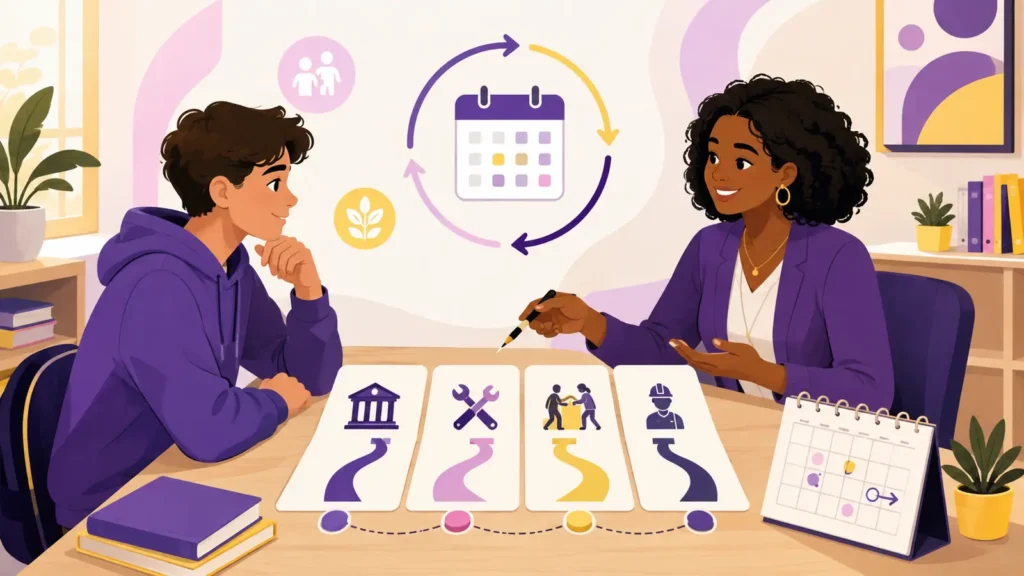
Use a simple cycle: notice a pattern, research an option, test it in real life, record what happened, and adjust. A useful high-school plan becomes more accurate as you gather evidence.
Why career planning in high school feels difficult
High school students are often asked what they want to become before they have seen how most jobs actually work. A job title may sound attractive while its everyday tasks, work setting or education requirements remain unclear. Family expectations, social media and pressure to choose subjects can make the decision feel more permanent than it is.
A better approach separates direction from commitment. Direction means choosing what to explore next. Commitment means investing substantial time or money in one pathway. You can build direction now while delaying major commitment until you have stronger evidence.
What this checklist is—and is not
It is a system for making the next informed decision. It is not a promise that one quiz result, favourite subject or childhood dream reveals the only career that will fit you.
Evidence to collect before choosing a direction
Start with observable clues rather than labels. Notice which assignments make you curious, which problems you volunteer to solve, what classmates ask you for help with and what type of effort feels satisfying. A strength is more credible when it appears repeatedly across subjects, projects or activities—not only when it feels easy once.
Then investigate the work itself. The U.S. Bureau of Labor Statistics Occupational Outlook Handbook explains common duties, work environments, education routes and outlook information for hundreds of occupations. O*NET OnLine adds detailed task, skill, interest and work-style information. Use these sources to compare reality with your assumptions.

Career planning checklist for high school students
| Checklist area | Evidence to collect | One useful action |
|---|---|---|
| Interests | Activities that hold your attention | Track energising tasks for two weeks |
| Strengths | Repeated performance and feedback | Ask two teachers for specific examples |
| Career research | Tasks, setting, education and outlook | Compare three occupation profiles |
| Real-world tests | Your response to actual tasks | Try a project, interview or job shadow |
| Pathway fit | Cost, time, entry requirements and flexibility | Compare college, training and work routes |
| Review | What changed after new evidence | Reassess at the end of each term |
1. Record interests as activities
Write down activities that hold your attention: explaining an idea, repairing something, analysing numbers, organising a group, designing a visual or caring for others. Avoid writing only broad subjects such as “science” or “art.” The activity tells you more about the kind of work you may enjoy.
2. Build a strengths evidence log
For each possible strength, add one example: a project you completed, feedback you received, a skill you learned quickly or a difficult task you improved through practice. Ask teachers, coaches and family members, “When have you seen me do this well?” Specific examples are more useful than compliments.
3. Explore career families before job titles
Group options into wider families—health, technology, skilled trades, education, business, public service, creative work or research. Pick three families and identify two roles in each. This prevents one familiar job title from narrowing your view too early.
4. Compare the daily work
- What tasks fill a normal day?
- Does the work involve people, data, ideas, tools or a mixture?
- Is the environment structured, flexible, quiet, active or unpredictable?
- What education, licence, portfolio or training is normally required?
- Which trade-offs—schedule, cost, location or pressure—matter to you?
5. Test promising options
A small test gives information that research cannot. Try a related class, club, volunteer role, personal project, informational interview, workplace visit or short course. Do not ask only, “Was it fun?” Record which tasks you enjoyed, what frustrated you, what you learned quickly and whether you want a deeper test.
The two-test rule
Before removing or committing to a career direction, complete at least two different tests. One experience may reflect a particular teacher, project or workplace rather than the occupation itself.
6. Compare education and training pathways
For each direction, list more than one route where possible: university, community college, vocational training, apprenticeship, certification, military training or entry-level work. Compare cost, time, admission requirements and the ability to change direction. The most prestigious route is not automatically the best fit.
7. Create a flexible 90-day plan
Choose one career family to investigate, one person to speak with and one real-world test to complete during the next 90 days. Add a deadline. A short plan is easier to act on than a perfect five-year plan built from guesses.
Worked example: from “I like biology” to useful evidence
Maya, a tenth-grade student, says she wants a healthcare career because biology is her favourite subject. Instead of choosing medicine immediately, she identifies the activities behind the interest: explaining body systems, interpreting evidence and helping nervous classmates understand a lesson.
She researches a physician, medical laboratory scientist, physiotherapist and public-health specialist. The daily tasks are quite different. Maya interviews a physiotherapist, joins a school health campaign and completes a short data project using public-health information. She enjoys analysing patterns and explaining findings but feels less drawn to hands-on treatment.
Her next decision is not “choose a career forever.” It is to take the next available statistics course, explore public-health and laboratory roles, and review the evidence at the end of the term. That decision keeps several paths open while making her next academic choice more informed.
Choose the next action and set a review date
Finish your checklist by writing one action that can produce new evidence within two weeks. It might be comparing three occupation profiles, asking a counsellor about subject prerequisites or arranging one informational interview. Put the action on your calendar and set a review date at the end of the term.
When you review, keep, adjust or replace your direction based on what you learned. If a test reduced your interest, it still succeeded—it prevented a larger commitment based on an assumption. For a broader framework, read career planning for students. You can also preview the next-stage university career checklist and learn how to approach career planning in your first university year.
Your next step
Use RoleQuiz to organise patterns in your interests, strengths and preferred environments, then treat the result as a starting hypothesis to test—not a final answer.
Frequently asked questions
What grade should career planning start?
Exploration can begin in any high-school grade. Earlier planning should focus on curiosity and broad exposure; later planning can add deadlines, prerequisites, applications and financial comparisons.
Do I need to choose one career in high school?
No. A practical outcome may be a shortlist of two or three career families plus a plan to test them. You need enough direction for the next decision, not certainty about your entire working life.
How often should I update my career checklist?
Review it at least once each school term and after a meaningful experience such as a new class, project, job shadow, volunteer role or conversation with someone in the field.
Can a career quiz choose a job for me?
A career quiz can organise patterns and suggest options you may not have considered, but it cannot observe every constraint, opportunity or real-world reaction. Use results to generate and prioritise tests.
Final takeaway
The best career planning checklist for high school students turns pressure into a sequence of manageable experiments. Collect evidence about yourself, investigate real work, test more than one option and review regularly. Each cycle should make your next choice clearer while preserving room to grow.
Leave a Reply