Author: Team

  • Career Interest Test vs Personality Test for Career Choice

    Career Interest Test vs Personality Test for Career Choice

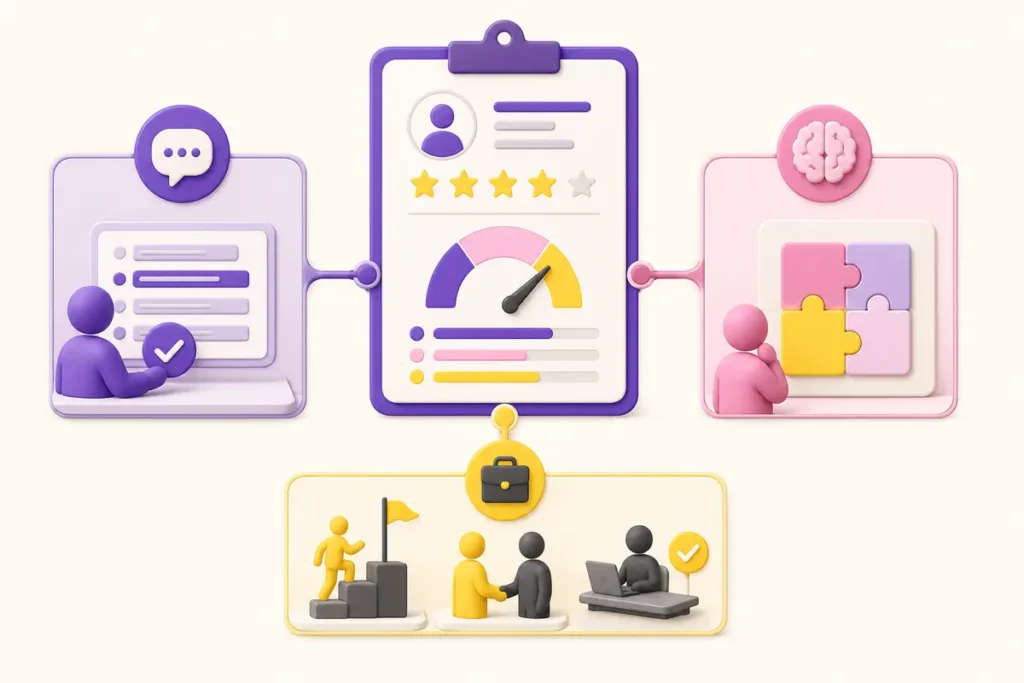
    A career interest test vs personality test comparison is really about two different questions. An interest test asks, “What kinds of work activities attract and energise me?” A personality test asks, “How do I usually behave, decide, communicate or respond to my environment?” Neither should choose a job for you. Used together, they can help you build a better shortlist—if you compare the results with real tasks, constraints and experience.

    Quick rule: use interest results to decide what to explore, personality results to decide which conditions to investigate, and direct experience to decide what deserves commitment.

    Career interest test vs personality test: the key difference

    QuestionCareer interest testPersonality test
    Main focusActivities and fields you are drawn towardTypical patterns in behaviour and preferences
    Useful forGenerating career families and tasks to exploreInvestigating work settings, interaction and structure
    Does not proveAbility, job success or lasting satisfactionOne ideal job or an unchangeable identity
    Best next stepResearch and try matching tasksCompare the result with behaviour across situations

    The distinction matters because people often ask one assessment to answer a question it was not designed to answer. A strong interest in analysing evidence does not reveal whether you prefer solitary concentration or collaborative discussion. Likewise, being organised does not tell you whether you want to organise financial data, patient care, events or laboratory work.

    What a career interest test can—and cannot—tell you

    A career interest test looks for patterns in activities you find appealing. Many tools organise interests into broad families. For example, O*NET’s career interest types describe work connected with practical building, investigation, creative expression, helping, persuasion and organising information. These patterns can introduce occupations you have not considered and give you useful language for comparing options.

    Interest results are about attraction, not proof

    If your results show strong Social and Investigative interests, you may enjoy helping people and understanding complex questions. That could support exploration of healthcare, teaching, counselling, user research, public health or many other paths. It does not prove that you have the qualifications, enjoy every task in those careers or want their working conditions.

    • Use it to: create a wider but relevant list of possibilities.
    • Check it against: activities that repeatedly hold your attention.
    • Do not infer: that a high-interest occupation will automatically suit your skills, values, lifestyle or opportunities.

    Student comparing career interest activities with personality and work-style preferences

    What a personality test can—and cannot—tell you

    A personality test estimates relatively consistent tendencies, such as how readily you seek social stimulation, prefer order, respond to novelty or express emotion. Depending on the test, results may be shown as traits, types or descriptive profiles. They can prompt good questions about work style, but the label should never become a career cage.

    Avoid the stereotype trap: “introverted” does not mean “cannot lead,” “creative” does not mean “disorganised,” and “conscientious” does not mean “must work in accounting.” Behaviour changes with skill, role, culture, confidence and context.

    Personality results are most helpful when translated into questions. Do you prefer scheduled conversations or constant interaction? Do you want clear procedures or room to improvise? Is deep individual focus important, or do you think better through discussion? These are conditions to investigate—not instructions to accept or reject a career.

    Why the two results may seem to conflict

    A conflict often appears because the tests describe different layers. You might be deeply interested in helping people while preferring quiet, planned interaction. That is not contradictory. It suggests you should compare forms of helping: one-to-one advising, emergency response, classroom teaching, community outreach and instructional design involve very different amounts and types of contact.

    Results can also differ because of mood, unclear questions, limited experience or the way a particular tool defines its scales. Quality matters. The Standards for Educational and Psychological Testing emphasise appropriate interpretation, validity, reliability and responsible test use. Before trusting a result, look for an explanation of what the assessment measures, how scores were developed and what conclusions are supported.

    Complete the interest–personality results map

    The most useful career interest test vs personality test exercise is not choosing a winner. It is mapping how the two sets of results interact. Copy the table below and complete one row for each strong pattern.

    Map stepWrite your evidenceTurn it into action
    Interest pullTasks or problems that attract youName three roles containing those tasks
    Personality conditionSettings where you usually function wellWrite one condition to verify in each role
    ConfidenceQuiz only, repeated experience or outside feedbackMark weak claims as questions, not facts
    IntersectionA task plus a workable settingDesign a small test of that combination
    Constraint checkTraining, cost, location, health and responsibilitiesRemove or adapt options that fail a real limit
    ReviewWhat the test confirmed or challengedKeep, revise or replace the hypothesis
    Interest-personality results map connecting assessment patterns to real-world career experiments and a review date

    1. Rewrite labels as observable statements

    Replace “I am an Artistic type” with “I repeatedly choose tasks where I can shape a message or make something original.” Replace “I am reserved” with “I contribute best when I can prepare before a discussion.” Observable statements are easier to test and less likely to become stereotypes.

    2. Rate the confidence behind each statement

    • Low confidence: one assessment result with no clear example.
    • Medium confidence: the result matches several past choices or experiences.
    • High confidence: the pattern repeats across settings and is supported by specific feedback.

    Low confidence does not mean false. It means “test this next.” High confidence still does not guarantee a career match; it simply gives you a stronger starting hypothesis.

    3. Find intersections instead of exact matches

    Combine one motivating activity with one preferred condition. “Explain complex ideas + time to prepare” might lead you to explore technical writing, tutoring, instructional design or research communication. “Solve urgent practical problems + active teamwork” might point toward operations, emergency services, field engineering or event production. The intersection creates a research direction, not a final job answer.

    4. Design one small reality test

    Choose an activity that reproduces part of the work: complete a short project, observe a professional, interview someone about a normal week, volunteer, attend a workshop or try an introductory course. Record which task held your attention, how the environment affected you, what felt draining and whether practice improved the experience.

    Worked example: when “Social” meets a quiet work style

    Aisha’s interest test highlights Social and Artistic activities. She likes explaining ideas, helping classmates and creating clear visuals. Her personality report describes her as reflective, easily tired by constant stimulation and more comfortable when she can prepare. She initially assumes the results conflict because she equates helping careers with nonstop group interaction.

    In her results map, Aisha changes the labels into evidence. She has repeatedly enjoyed one-to-one tutoring and designing study guides. She disliked running a crowded club event but liked planning its materials. Her interest evidence is strong; her preference for planned, lower-stimulation interaction is medium-to-strong.

    Instead of removing people-focused work, she compares school counselling, classroom teaching, instructional design and user education. She interviews an instructional designer, creates a short learning guide for a volunteer group and observes a counsellor’s scheduled one-to-one work. The project confirms that she enjoys combining explanation, design and focused interaction. She keeps instructional design and counselling on her shortlist and sets a six-week review date after another test.

    Important: when results disagree, do not average them into a vague label. Identify the exact task that attracts you, the exact condition that concerns you, and an experience that tests both at once.

    Which test should you take first?

    Start with the question you need to answer. If your problem is “I do not know what fields or activities to explore,” begin with a career interest test. If you already have options but do not understand why particular environments feel easier or harder, a personality or work-style assessment may add useful questions. If possible, use both—but compare their purpose and quality before comparing their scores.

    Choose a next step and set a review date

    Complete your map with one action that can produce evidence within the next two weeks. Then choose a review date four to eight weeks later. At the review, ask: Which result matched my behaviour? What surprised me? Did I dislike the task, the setting or simply being new at it? Which option deserves a deeper test?

    For the wider framework, read what a career assessment actually measures. Then explore whether a career test can choose a job for you and what to do when you disagree with career-test results.

    Frequently asked questions

    Is a career interest test more accurate than a personality test?

    They measure different things, so accuracy is not a simple contest. Check whether each assessment is appropriate for its stated purpose, supported by evidence and interpreted within its limits. A well-designed interest measure may be useful for exploration, while a well-designed personality measure may describe tendencies; neither alone proves career fit.

    Can personality change enough to affect career results?

    People show some consistency, but behaviour also varies by situation, experience, development and role. Treat a personality score as a description of current tendencies, then check it against several settings instead of assuming it is permanent.

    What if my career interest and personality results conflict?

    Translate both results into observable statements, rate the evidence behind each one and test an intersection. For example, if you enjoy helping but dislike constant group contact, explore roles with structured or one-to-one helping rather than discarding the whole interest area.

    Can either test tell me the best career?

    No single result can include every skill, value, constraint, opportunity and reaction to real work. Use assessments to generate hypotheses and questions. Research occupations and test relevant tasks before making a high-cost commitment.

    Final takeaway

    In a career interest test vs personality test comparison, interests describe what may pull you toward work; personality describes how you may approach it. Combine the two in an evidence map, challenge weak assumptions and test promising intersections in real life. The goal is not a perfect label. It is a better next experiment and a clearer decision.

    Ready to organise both sides? Try RoleQuiz to receive a personalised assessment report, then use the results as hypotheses to research, test and refine.


  • How Parents and Students Should Use Career-Test Results Together

    How Parents and Students Should Use Career-Test Results Together

    How parents and students should use career test results is simple in principle: treat the report as a conversation starter, not a verdict. The student should explain what feels accurate, surprising or incomplete. The parent should ask questions, add observations and help check practical facts. Together, they should turn two or three promising patterns into small research tasks or real-world experiments before making an expensive education or career decision.

    The shared goal

    Leave the conversation with a better question and one useful next step—not pressure to choose a lifelong career in one evening. A result becomes valuable when it helps a student explore with more direction while keeping ownership of the decision.

    Career assessments can organize information about interests, preferences, values, strengths or work styles. They can also create tension. A parent may see a prestigious or secure option in the results, while the student notices a completely different pattern. The method below helps families use the same report without turning it into an argument.

    Why career-test conversations become difficult

    Students and parents usually want the same outcome: a future that is satisfying, realistic and sustainable. They may still approach the report with different fears. A student may worry about being boxed into a label. A parent may worry about employability, cost, safety or missed opportunities. When those concerns are not named, a neutral score can start to feel like evidence in a debate.

    Career-test language can sound more precise than it really is. A match percentage, personality label or ranked list may look final, yet it reflects a defined set of questions answered at one point in time. It may not capture emerging skills, local opportunities, disability or access needs, family circumstances, financial constraints, or how the student experiences a real workplace.

    A useful rule

    Say “This result suggests…” rather than “This result proves…”. That small change keeps the report open to evidence, growth and revision.

    What a career assessment can—and cannot—tell you

    A well-designed assessment can reveal patterns worth investigating. Depending on the tool, it may highlight activities the student enjoys, capabilities they use confidently, values they want from work, or environments in which they may prefer to operate. These patterns can generate career families and questions for further exploration.

    • It can suggest: recurring interests, preferred tasks, work values, possible strengths and career families to research.
    • It cannot guarantee: future happiness, admission to a program, job success, salary, or a perfect match.
    • It can improve self-awareness: especially when the student compares the result with real experiences.
    • It cannot replace evidence: course requirements, daily job tasks, costs, labour-market information and direct exposure still matter.

    The U.S. Department of Labor describes O*NET career-exploration tools as resources that help people consider and plan career options, preparation and transitions. The emphasis is exploration. Similarly, the American School Counselor Association recommends combining assessments with career research, conversations and hands-on opportunities such as job shadowing or internships.

    Evidence to collect before the family discussion

    Student and parent sort evidence cards through a shared career-results discussion
    A good discussion moves from listening to evidence, exploration and one agreed next step.

    Do not begin by arguing about the top occupation. Begin by collecting evidence from four places. First, read the assessment’s explanation of what it measures and how to interpret scores. Second, gather examples from the student’s actual life. Third, research the suggested work. Fourth, record practical constraints without allowing those constraints to erase the student’s voice.

    Evidence sourceQuestions to answerWhat to record
    Assessment reportWhat dimensions were measured? Which scores are close together?Top patterns, not only the first job match
    Student experienceWhen has the student shown this interest, strength or value?Two or three specific examples from classes, projects, hobbies or work
    Career realityWhat are the daily tasks, training routes and work environments?Facts from O*NET, BLS, course pages and professionals
    Practical contextWhat costs, location, access or timing limits matter?Constraints plus possible alternatives—not automatic rejections

    Keep observation separate from interpretation

    Observation: “You spent three weekends improving the robotics project.” Interpretation: “You must become an engineer.” The observation is useful evidence; the interpretation is only one possible explanation.

    How parents and students should use career test results: a six-step guide

    1. Read the report separately

    Give the student time to read the full result before discussing it. Ask both people to mark three things: one point that feels accurate, one surprise and one part that seems wrong or incomplete. A short pause reduces the chance that the loudest first reaction controls the conversation.

    2. Let the student speak first

    The student explains their marked points without interruption. Parents listen for experiences behind the reaction: “Which class, project or activity made that feel true?” The purpose is not to cross-examine the student. It is to connect an abstract score with lived evidence.

    3. Translate labels into behaviour

    Replace broad labels with observable actions. “Creative” might mean generating concepts, explaining ideas visually, designing systems or solving open-ended problems. “Social” might mean teaching, persuading, caring, facilitating or working in a lively team. The same label can point toward very different careers.

    4. Build a shortlist, not a winner

    Choose three to five options that express the strongest patterns in different ways. Include at least one option the student already knows, one adjacent possibility and one unfamiliar option. A shortlist prevents a single test match from becoming a command.

    5. Test the shortlist with real evidence

    For each option, review daily tasks, education routes, costs, working conditions and outlook. Then choose a low-risk experiment: complete a mini project, interview a professional, observe a workplace, attend a class, volunteer, or try a reputable job simulation. Experience can confirm, refine or contradict the report.

    6. Agree on one action and a review date

    End with a named action, an owner and a date. For example: “Sam will interview a physiotherapist by 20 September; Mum will help arrange the introduction; we will review what Sam learned that weekend.” A review date makes exploration feel purposeful without pretending the decision is permanent.

    StepStudent’s roleParent’s roleShared output
    ReadMark accurate, surprising and missing pointsRead the method and note questionsTwo sets of notes
    ExplainSpeak first and give examplesListen and ask open questionsEvidence behind the scores
    TranslateDescribe preferred activitiesHelp make labels specificPlain-language patterns
    ShortlistChoose options worth exploringAdd possibilities, not commandsThree to five options
    TestComplete a real-world experimentRemove access barriers where possibleNew evidence
    ReviewSay what changedDiscuss trade-offs calmlyNext step and review date

    Worked example: Aisha and her father

    Aisha, a 16-year-old student, receives high scores for investigative interests and structured work. Her report lists medicine, laboratory science, accounting and data-related roles. Her father immediately focuses on medicine because it seems secure and respected. Aisha says the result is partly accurate: she enjoys analysing patterns in biology and spreadsheets, but she dislikes clinical environments and does not want years of patient-facing training.

    Instead of debating whether medicine is “best,” they use the guide. Aisha gives evidence from a school survey project where she cleaned data and presented findings. Her father adds that she is patient with complex problems and consistently checks details. They translate the scores into three behaviours: analysing information, improving accuracy and explaining findings clearly.

    Their shortlist becomes health data analysis, laboratory quality work and user research, with medicine retained only as a comparison. Aisha reviews occupation profiles, speaks with a family friend who works in a laboratory and completes a short data-analysis project. Two weeks later, she decides to explore data and research pathways further. The assessment did not choose for her; it helped the family design a better experiment.

    Notice what changed

    The parent’s concern about stability remained part of the discussion, but it became a research question. The student’s preference remained central, but it also had to be supported with action and evidence.

    Student tests career ideas through a mini project, workplace observation and conversation
    Small real-world experiments help a student confirm, refine or reject an assessment suggestion.

    Questions that keep the conversation productive

    Parents can support autonomy without becoming passive. Students can own the decision without ignoring practical realities. These questions help both sides contribute.

    • For parents: What part of this result feels most like you? What evidence supports that? Which option are you curious enough to test? What barrier can I help remove?
    • For students: Which recommendation fits your experience? Which one does not? What concern is your parent raising? What small action could give both of you better evidence?
    • For both: Are we discussing a fact, a preference or a fear? What information would change our minds? When will we review the decision?

    What to do when parents and students disagree

    First, identify the type of disagreement. A factual disagreement—such as program cost or entry requirements—can be researched. A preference disagreement—such as city versus home—requires trade-offs. A fear—such as “this career will never be secure”—should be named and tested against reliable information rather than treated as certainty.

    If the discussion becomes heated, pause it. Return later with a school counsellor, career adviser or another trusted adult who can protect the student’s voice while helping the family examine evidence. The goal is not to force agreement on a job title; it is to agree on a responsible way to learn more.

    Students facing strong pressure may also find our guide on what to do when parents disagree with a career choice useful.

    Common mistakes to avoid

    • Treating the highest match as the only acceptable option.
    • Using one personality label to explain every preference or ability.
    • Ignoring careers that are unfamiliar to the family.
    • Discussing salary without checking daily tasks, training cost and work environment.
    • Asking the student to decide immediately after seeing the results.
    • Repeating assessments instead of testing ideas in the real world.

    Decide the next action and when to reassess

    Choose one career pattern from the report and turn it into a seven-day task. Read two occupation profiles, watch or observe the work, speak with one person in the field, and complete one small activity related to the role. Record what increased energy, what reduced it and what questions remain.

    Revisit the shortlist after the experiment, after a major academic experience, or when the student’s interests, skills or circumstances change. Reassessment does not mean the first result failed. It means the family is updating the decision with better evidence.

    Explore the patterns behind the result

    Try the RoleQuiz career assessment to identify possible interests, abilities and personality patterns. Then use this family discussion guide to turn the report into questions, experiments and a clearer next step.

    Related RoleQuiz guides


    Frequently asked questions

    Should parents see a student’s full career-test report?

    Ideally, the student agrees to share it and remains present when it is discussed. A collaborative approach builds trust and makes the interpretation more accurate because the student can explain which parts fit their experience. Schools and assessment providers should also follow their own privacy and consent requirements.

    What if a student rejects every suggested career?

    Inspect the underlying dimensions before dismissing the whole assessment. The occupation list may be too narrow even when an interest or work-style pattern is useful. Translate the pattern into tasks, then search for different roles that use those tasks.

    Can a parent recommend careers that were not in the results?

    Yes—offer them as possibilities, explain why they may connect to the student’s evidence, and invite the student to test them. A recommendation becomes pressure when it is presented as the only acceptable outcome.

    How often should students retake a career assessment?

    There is no universal timetable. Revisit it when the student has gained meaningful new experiences, when their goals or circumstances change, or when the original result no longer helps decision-making. Real-world experiments are usually more valuable than repeatedly taking similar quizzes.

    Sources and further exploration

    This article is educational and does not replace individual guidance from a qualified school counsellor, career adviser or psychologist.

  • How to Interpret a Career Assessment Report Step by Step

    How to Interpret a Career Assessment Report Step by Step

    To understand how to interpret a career assessment report, read it as a set of hypotheses—not a verdict. Start with what the assessment measures, notice your strongest patterns and any near-ties, then translate each result into questions about tasks, environments and skills. Use suggested careers as a research list, verify them with reliable occupation information and small real-world tests, and choose one next action. A useful report should improve your exploration; it should never choose your future for you.

    Quick answer: Use this sequence: measure → pattern → hypothesis → evidence → action. Identify what the score represents, describe the pattern in plain language, turn it into a career hypothesis, test that hypothesis with external evidence, and schedule a review date.

    Before interpreting scores, check what the assessment measures

    Two career assessments can produce very different reports because they ask different questions. An interest inventory may describe activities you tend to enjoy. A values assessment may focus on outcomes and working conditions that matter to you. A skills or aptitude measure may estimate current capability, while a personality-based report may describe behavioural preferences. None of these categories means exactly the same thing.

    Read the report introduction, method or “about your results” section before looking at the career matches. Ask: What construct was measured? What was the comparison group, if any? Are scores ranks, percentages, percentiles or broad bands? Does a low result mean dislike, less evidence, or simply a lower relative score? If the report does not explain its scales, be cautious about precise conclusions.

    The Standards for Educational and Psychological Testing emphasise issues such as validity, reliability, administration and appropriate score use. In plain language, an assessment should support the interpretation you are making. A vocational-interest result can guide exploration; it is not automatically evidence that you have the training, ability or circumstances required for every matched occupation.

    Do not combine unlike scores. A 75th percentile and a 75% match are not interchangeable. Use the definitions supplied by that specific report instead of assuming every number has the same meaning.

    What the main sections of a career assessment report usually mean

    Report sectionUseful interpretationQuestion to ask
    Top themes or dimensionsYour strongest relative patterns on the measured constructWhich activities or conditions does this theme describe?
    Score graphThe shape of your profile, including clusters and near-tiesAre the differences large enough to matter?
    Career matchesOccupations linked to the measured patternWhich real tasks created the match?
    Development suggestionsIdeas for exploration, learning or skill practiceWhich suggestion can I test cheaply?
    Warnings or confidence notesLimits caused by missing answers, inconsistent responses or score rulesShould I clarify or repeat anything?

    Look at the whole profile before focusing on the single highest score. Two close scores may be more informative together than either one alone. For example, a strong Social pattern and a similarly strong Investigative pattern may suggest curiosity about work that combines helping with analysis. That is a direction to explore, not a command to enter one named profession.

    How to interpret a career assessment report in six steps

    1. Write the assessment question in one sentence

    Complete this sentence: “This report is designed to help me understand…” Your ending might be work interests, preferred environments, values, strengths or another clearly defined area. This prevents you from using an interest result as if it measured every part of career fit.

    2. Translate each major score into plain language

    Avoid identity labels such as “I am an Enterprising person” or “I am not creative.” Use a testable statement instead: “I may prefer persuading, organising people or taking initiative,” or “Artistic activities ranked lower than my other interests in this assessment.” Plain language keeps the result flexible and reduces stereotyping.

    3. Notice combinations, gaps and near-ties

    Circle your top two or three dimensions and record how far apart they are. A small gap may not justify treating one theme as dominant. Then compare the result with your recent experiences. Where does it agree with evidence from classes, projects, volunteering or work? Where does it surprise you? Surprises are questions to investigate, not mistakes to erase.

    4. Convert career matches into task-level hypotheses

    Do not ask only, “Do I like this job title?” Ask why it appeared. A user researcher, occupational therapist and academic adviser could all match a similar interest pattern for different reasons. Write the probable connection as a task: interviewing people, investigating needs, explaining options, analysing information or coordinating support.

    5. Verify each promising match with outside evidence

    Use a reliable occupation source to check daily tasks, work context, required preparation and related roles. The O*NET OnLine database describes occupations in detail, while the official O*NET Interest Profiler demonstrates how interest results can be linked to career exploration. If you live outside the United States, add your country’s official education and labour-market sources because entry requirements vary.

    Then collect first-hand evidence. Speak with someone doing the work, observe a workflow, take an introductory lesson or complete a small project based on a realistic task. The report tells you where to look; the experiment tells you what the work feels like.

    Student verifying career assessment results with occupation research and a practical project
    Use occupation research, conversations and small projects to verify the patterns in a career report.

    6. Choose one next action and a reassessment date

    Finish with a decision that is small enough to complete: compare three occupation profiles, arrange one informational interview, try a two-hour task sample or discuss unclear results with a qualified career professional. Set a review date two to four weeks later. At that review, update your interpretation with the evidence you collected.

    Evidence rule: Every important interpretation should produce a verification task. If a report says you may enjoy investigative work, choose one investigative activity to try instead of merely accepting the label.

    Career report interpretation worksheet

    Copy this table into a notebook or document. Complete one row for each major result or career suggestion. The final column matters most because it turns reflection into evidence.

    ResultPlain-language hypothesisEvidence I already haveEvidence missingNext verification task
    Top interest or themeI may enjoy…Examples from study, work or lifeWhat I still do not knowActivity, conversation or research step
    Second close themeI may also prefer…Examples that support itPossible conflict or uncertaintyCombined task to test
    Career suggestionThis appeared because…Relevant experienceDaily work and entry requirementsProfile research plus one first-hand check
    Unexpected resultThis might mean…Evidence for and againstReason for the surpriseRepeat, clarify or test in context
    Career report interpretation worksheet with assessment charts and evidence notes
    Translate each result into a plain-language hypothesis, missing evidence and one verification task.

    Worked example: interpreting a mixed result

    Imagine Aisha receives high Social and Investigative interest scores, with Artistic close behind. Her report suggests healthcare education, user research, counselling and community programme roles. At first, the variety feels confusing. Instead of choosing the first title, she looks for the shared activities: understanding people, investigating problems, explaining information and improving an experience.

    Aisha checks occupation profiles and learns that the matched roles differ in education, emotional demands, data use and work setting. She interviews a user researcher and a health educator, then creates two small samples: analysing five mock interview notes and designing a one-page public-health explainer. She enjoys finding patterns in the interview data and likes explaining the result, but she wants more evidence about sustained client-facing work.

    Her conclusion is not “the test chose user research.” It is: “Work combining investigation, human needs and communication deserves a deeper trial.” Her next action is a short research project, followed by a review in one month. That conclusion is narrower, better supported and still open to revision.

    Better conclusion: “This pattern is worth testing” is usually more useful than “This is who I am.” Career reports work best when they make your next experiment more focused.

    How to handle low scores, near-ties and surprising matches

    • Low scores: treat them as lower relative signals, not permanent inability. Check whether the scale measures enjoyment, confidence or demonstrated skill.
    • Near-ties: explore the combination. A small difference may not justify excluding the second theme.
    • Unexpected matches: identify the task or work condition behind the suggestion before rejecting it.
    • Too many matches: filter by practical constraints, preferred tasks and evidence quality rather than trying to research every title.
    • No appealing matches: return to the measured themes and build a fresh list. A report’s occupation database may be narrower than the world of work.

    If your shortlist feels crowded, use the guide on what to do when a career test gives you too many matches. If none of the suggestions feels suitable, read what to do when no career-test result feels right. Both problems can be solved more effectively by returning to the underlying evidence.

    Common mistakes when reading career assessment results

    • Treating the first matched career as a recommendation or instruction.
    • Ignoring the report’s definition of scores, ranges and comparison groups.
    • Overinterpreting a tiny gap between two scores.
    • Assuming a low preference score proves low ability.
    • Researching titles without checking ordinary tasks, work context and preparation.
    • Using one report to overrule practical constraints, health needs or important work values.
    • Repeatedly taking new quizzes instead of testing the strongest current hypothesis.

    When to ask for professional help

    Ask the assessment provider, a school counsellor or a qualified career professional for clarification when scoring rules are unclear, the report includes technical language you cannot verify, results strongly conflict with repeated experience, or the decision has expensive or difficult-to-reverse consequences. For formal psychological, ability or clinical assessments, interpretation may require appropriately trained professionals.

    Use RoleQuiz as an exploration tool. Review the RoleQuiz Study & Career Assessment to identify patterns worth investigating, then combine the result with occupation research, real tasks and your practical constraints. Try RoleQuiz and receive a personalised assessment report.

    Frequently asked questions

    Are higher career assessment scores always better?

    No. A higher score usually means more of the measured construct, not greater human worth or guaranteed career success. Interpret it using that assessment’s definitions and compare it with your other scores and real-life evidence.

    What if my top two scores are almost equal?

    Treat them as a combined pattern. Look for careers and tasks that use both themes, then test whether the combination is important in practice. Do not force a winner from a small difference unless the report explains why that gap is meaningful.

    Should I retake a career assessment?

    Retake it when the provider recommends a repeat interval, you rushed or misunderstood many items, your circumstances have changed substantially, or you want to compare a later profile. Do not retake it immediately just to chase a preferred answer.

    Can a career assessment predict whether I will succeed?

    Not by itself. Success depends on many factors, including opportunity, training, effort, health, support, workplace conditions and how the measured characteristic relates to the role. Use results to improve exploration and questions, not to predict a guaranteed outcome.

    How many career matches should I research?

    Start with three to five that represent different task combinations. Complete a quick evidence pass, then take the strongest two into deeper research, conversations or project samples. A smaller tested shortlist is more useful than dozens of unexamined titles.

    Turn your report into a better next decision

    The most reliable way to understand how to interpret a career assessment report is to move from scores to plain-language hypotheses, from hypotheses to evidence, and from evidence to one practical action. Respect the report’s purpose and limits, look for patterns rather than one winning number, and verify suggestions through real tasks and credible occupation research. You do not need the report to reveal a permanent identity. You need it to help you ask better questions and make a better-informed next move.

    Sources and further reading

  • What to Do When No Career-Test Result Feels Right

    What to Do When No Career-Test Result Feels Right

    If your career test gives no suitable matches, do not force yourself to accept the least-wrong result or conclude that you have no direction. First check what the assessment actually measured, whether your answers reflected your present reality, and whether you are interpreting broad patterns as narrow job prescriptions. Then widen the search one step at a time and test promising themes through research, conversations and small experiences.

    Quick answer: Treat a no-match result as a troubleshooting signal. Check the test’s purpose, review the dimensions behind the recommendations, identify any answers distorted by stress or expectations, broaden the filters, and collect real-world evidence. A career assessment should support exploration—not issue a final verdict.

    Why No Career-Test Result Feels Right

    A career assessment compresses complicated information into a manageable pattern. Depending on the tool, it may compare interests, work values, personality preferences, skills, confidence or preferred environments. No single test can capture every constraint, emerging interest, cultural expectation, health need, financial reality or version of a job.

    The result may also be technically reasonable yet feel wrong because the occupational examples are too specific. A pattern such as “investigative and creative work with autonomy” can appear as laboratory, design or research roles, but the underlying combination exists in many other settings. Rejecting three job titles does not necessarily mean the pattern is useless.

    Professional testing standards emphasise appropriate interpretation, evidence and intended use. The American Psychological Association’s testing standards resources are a useful reminder that scores must be understood in context. For career decisions, a result is best used as one source of evidence alongside experience, constraints and informed discussion.

    What a no-match result does not mean: It does not prove that you lack strengths, that every career will be unsuitable, or that you answered “incorrectly.” It means the current combination of tool, answers, interpretation and options has not yet produced a useful next hypothesis.

    Career Test Gives No Suitable Matches? Use This Six-Step Guide

    1. Check What the Test Was Designed to Measure

    Read the methodology or result explanation. Was the assessment designed to describe interests, abilities, personality, values or occupational fit? An interest inventory should not be treated as a skills test. A personality measure cannot determine whether you meet an occupation’s education requirements. If the report mixes these ideas without explaining them, lower your confidence in the job list and focus on any transparent dimension scores.

    Also check the intended audience. A student exploring broad fields needs a different level of precision from an experienced professional considering a specialised transition. A result can feel irrelevant when the test assumes a life stage, location or qualification level that does not match yours.

    2. Separate the Pattern From the Job Titles

    Hide the recommended occupations for a moment. Write down only the recurring clues: the problems you might enjoy solving, people or information you prefer working with, level of structure, pace, independence, practical activity and type of outcome. Circle any clue that feels accurate based on past behaviour—not merely on how you wish to appear.

    Now translate those clues into work ingredients. “Helping” could mean teaching, advising, coordinating, designing accessible systems or improving public services. “Creativity” might mean visual expression, experimentation, writing, product improvement or finding new processes. This translation prevents a short list of unfamiliar titles from closing a much wider field.

    3. Audit the Answers You Gave

    Think about the conditions under which you completed the assessment. Were you tired, rushed or trying to satisfy a parent, teacher or employer? Did you answer according to what you are good at, even when you do not enjoy it? Did you choose an idealised preference with no evidence from real situations? These are common sources of noise.

    Do not repeatedly retake the same test until it gives a pleasing answer. Instead, flag uncertain questions and attach one example to each answer. “I like organising” becomes stronger when supported by “I voluntarily planned the group project and enjoyed tracking the details.” Evidence makes your self-report more stable.

    4. Identify the Type of Mismatch

    Use the scorecard below. A precise diagnosis is more useful than a general feeling that “nothing fits.”

    Mismatch signalLikely issueUseful next move
    The themes fit, but the jobs do notOccupational list is too narrowSearch for roles sharing the same work ingredients
    Some answers feel unlike youResponse conditions or wording distorted the profileReview answers with behavioural examples
    Jobs sound interesting but unrealisticPractical constraints were excludedAdd location, cost, training and lifestyle filters
    Every option feels equally flatLimited exposure or low current energyCollect small experiences before choosing
    Two opposite themes both feel trueYou may need a hybrid role or varied environmentExplore roles combining both patterns
    A no-match troubleshooting scorecard for turning vague discomfort into a specific next action.

    Score each signal from 0 to 2: 0 = not present, 1 = possible, 2 = clearly present. Start with the highest-scoring issue. Changing every assumption at once makes it impossible to learn what improved the result.

    Career test result diagnosis using interests skills values environment and practical constraints
    Troubleshoot the mismatch by checking each part of the result instead of rejecting the whole assessment.

    5. Widen Exploration Safely

    Broaden one layer, not everything. If a recommended role is too specific, move up to its field. If the field feels wrong, return to the underlying activity. For example, “environmental scientist” might become environmental work, then investigation using evidence, then roles where research supports practical decisions. Each step creates new possibilities without producing an overwhelming list of hundreds.

    Use reliable occupational information to compare daily tasks, skills and environments. Then choose two or three low-cost experiments: watch a detailed work demonstration, interview a practitioner, complete a short project, attend a public class or volunteer in a bounded role. The purpose is not to prove you belong; it is to notice where curiosity, energy and willingness to improve appear.

    Safe widening rule: Add no more than three new career hypotheses at a time. For each one, record the pattern it matches, the concern it raises and the smallest test you can complete within seven days.

    6. Decide Whether to Retake, Try Another Tool or Move On

    Retake the same assessment only when you can identify a correctable problem: you misunderstood instructions, rushed, answered for someone else or completed it during an unusual period. Try a different assessment when you need another dimension, such as work values rather than interests. Choose tools that explain their purpose, method and limits.

    Move on to real-world exploration when repeated tests produce similar themes but different job titles. At that point, another score is unlikely to resolve the uncertainty. A conversation or realistic task can reveal more about fit than another hour of questionnaires.

    Student widening career exploration through low-risk conversations projects and work settings
    Broaden career exploration one layer at a time, then test a few hypotheses through small experiences.

    A Realistic Example: When Every Suggested Career Feels Wrong

    Imagine Noor, a university student, receives recommendations for accountant, data analyst and laboratory technician. None feels right. Noor initially assumes the test has failed. Looking underneath the titles, however, the report shows a preference for careful investigation, pattern detection and independent work.

    The titles feel wrong for different reasons. Accounting appears repetitive, data analysis seems too screen-based and laboratory work requires training Noor does not want. The underlying pattern still fits experiences Noor enjoyed: researching a difficult topic, checking claims and turning findings into a clear explanation.

    Noor widens exploration by one layer and considers user research, policy research and market insight roles. A short interview reveals that user research combines evidence, conversation and explanation. Noor tests the hypothesis by analysing five fictional interview notes and summarising themes. The task is imperfect but engaging, so the next step becomes a beginner research project—not an immediate degree change.

    Complete the No-Match Troubleshooting Guide

    Write one sentence for each prompt. Keep the answers specific enough to act on.

    • The result I received: List the main themes and recommended roles separately.
    • What feels accurate: Name two patterns supported by real examples.
    • What feels wrong: Identify whether the problem is the task, environment, training route, lifestyle or title.
    • What the test did not include: Add important constraints or preferences.
    • Three wider hypotheses: Choose adjacent roles or fields linked to the accurate patterns.
    • One seven-day test: Select a conversation, observation or sample task.
    • Review date: Decide when you will compare the new evidence.

    When a No-Match Result Needs Extra Support

    Ask a qualified career counsellor, school adviser or trained practitioner for help when the report is confusing, the decision has major financial consequences, or family pressure makes honest interpretation difficult. Bring the full report, your notes and examples from work, study or volunteering. A useful discussion should clarify evidence and options rather than simply select a job for you.

    If every activity feels empty across study, work and personal life—not only in career planning—consider speaking with an appropriate health professional. A career test is not designed to diagnose wellbeing concerns, and low energy can temporarily flatten preferences.

    Use Related Career-Assessment Guides

    To understand the foundation first, read what a career assessment measures. When you have a detailed report, use the guide on how to interpret a career assessment report. Families can also review how parents and students should use career-test results without turning the score into pressure.

    Ready for a more useful starting point? Try the RoleQuiz Study & Career Assessment and use the personalised report to identify patterns, questions and practical experiments. Keep the final decision in your hands: the assessment suggests directions; your evidence tests them.

    Frequently Asked Questions

    Why did my career test give me no suitable matches?

    The tool may measure a limited set of dimensions, your answers may reflect mixed or changing preferences, or the occupational database may be too narrow. Review the underlying themes and practical constraints before rejecting the entire result.

    Should I retake a career test if the results feel wrong?

    Retake it when you can identify a problem such as rushing, misunderstanding instructions or answering according to expectations. Avoid repeated retakes simply to obtain a preferred title.

    Can a career test be completely wrong?

    Yes, a result can be unhelpful or poorly matched to its intended use. Even a well-designed assessment has limits. Judge its value by the transparency of its method and whether the patterns lead to useful, testable exploration.

    What should I do after getting no career matches?

    Diagnose the mismatch, extract any accurate themes, add missing constraints and choose two or three broader hypotheses. Then test one through reliable research, a practitioner conversation or a small representative task.

    Final Takeaway

    When a career test gives no suitable matches, the best response is not to force a choice or abandon career exploration. Inspect what was measured, separate patterns from job titles, review your answers, diagnose the mismatch and widen the search gradually. The goal is not a perfect label. It is a useful next hypothesis supported by enough evidence to take one sensible step.

  • Why Career Test Results Can Change Over Time

    Why Career Test Results Can Change Over Time

    Career test results can change over time because your answers reflect both relatively stable preferences and your current context. Mood, recent experiences, unfamiliar questions and different test designs can create small shifts. Larger, repeated changes may reflect genuine development in your interests, confidence, priorities or life circumstances. Compare patterns across time and real-world evidence instead of treating either score as a final verdict.

    Quick answer: A changed result does not automatically mean the test failed—or that you became a completely different person. First check the size and consistency of the change, the conditions in which you tested, and whether your behaviour outside the quiz changed too.

    Why career test results change over time

    A career assessment is a structured snapshot, not a permanent label. It asks you to respond to statements or activities at a particular moment, then summarizes patterns such as interests, work values, personality preferences or perceived strengths. Some of those patterns are reasonably stable. None are completely isolated from experience and context.

    The professional Standards for Educational and Psychological Testing distinguish evidence about validity from evidence about reliability or precision. In plain language, a useful assessment must support the interpretation you want to make, while also showing an acceptable level of consistency. Consistency never means every score must be identical forever.

    Research behind the O*NET Interest Profiler includes separate work on reliability, validity and how interest results connect to occupations. That is a useful model for readers: ask what the assessment measures, how well it measures it, and what decisions its results can reasonably support.

    Use results as hypotheses. “This pattern may suit me” invites investigation. “This score proves my career” gives one questionnaire more authority than it deserves.

    Five reasons the same person can receive different results

    1. Normal measurement noise

    Every questionnaire contains some uncertainty. You may interpret an item differently, hesitate between two response options or answer a borderline question one step higher than before. When several scores are close, a few changed answers can alter their order even though the underlying profile remains broadly similar.

    This is especially common when reports highlight only the top category. A profile that previously ranked Social at 72 and Artistic at 70 may later reverse them. The headline changes, but the meaningful conclusion may still be that both patterns are prominent.

    2. Your testing conditions changed

    Fatigue, stress, distraction and time pressure can influence how carefully you read and how strongly you react. A student answering after an exhausting exam week may focus on safety and predictability. The same student during a relaxed holiday may feel more open to novelty and exploration.

    Context does not make the result useless. It tells you which version of your current priorities was sampled. Record the conditions so you can distinguish a temporary state from a repeated pattern.

    3. Recent experiences are unusually vivid

    People often answer with the most available example in mind. A brilliant group project can temporarily raise enthusiasm for teamwork. A conflict with a supervisor can lower interest in leadership or client-facing work. This recency effect may fade, or it may reveal something important that deserves further testing.

    4. Your self-knowledge improved

    A first-time assessment taker may answer according to school subjects, imagined jobs or other people’s expectations. After an internship, volunteer role or difficult course, the person has more accurate evidence. The later score may be different because the later answers are better informed.

    Improved self-knowledge is not instability. It is one reason assessments are more valuable when paired with real experiences. If communication is part of your changing profile, use the evidence method in how to use communication strengths in career choice rather than relying on how “good at communication” feels in the abstract.

    5. Genuine development or life change occurred

    Interests and priorities can develop as you gain competence, responsibilities and exposure. A new caregiving role may make schedule flexibility more important. Mastering a technical skill may increase enjoyment of analytical work. A change in health, finances, location or family expectations can alter which environments are realistic and sustainable.

    Genuine change is most credible when it appears across multiple sources: repeated assessments, daily choices, feedback, work samples and the activities you voluntarily continue. One surprising score is a prompt to investigate; a repeated behavioural pattern is stronger evidence.

    Career test measurement noise compared with genuine personal development
    Small fluctuations may come from context; repeated changes supported by behaviour are stronger evidence of development.

    How to tell measurement noise from a meaningful change

    Do not ask only, “Did the label change?” Ask how much changed, where it changed and whether the new pattern survives a fair comparison. Begin with the full score profile if the assessment provides one. Adjacent categories swapping places is different from a broad movement across several related dimensions.

    Observed patternLikely explanationEvidence to checkBest next action
    Top two categories swap but remain closeNormal score variation or tieFull scores, not only the headlineTreat both as active possibilities
    One scale shifts after a stressful weekTemporary context effectSleep, stress, time pressure, interruptionsRetake later under calmer conditions
    A score changes after a new project or internshipNew information or skill exposureWhat tasks you actually enjoyed and repeatedRun another similar work sample
    The same shift appears across months and behavioursPossible genuine developmentChoices, feedback, portfolio and prioritiesUpdate the shortlist and test it
    Different tests produce different labelsDifferent constructs, wording or scoringWhat each tool claims to measureCompare dimensions, not brand labels
    Everything changes dramatically overnightPoor conditions, rushed answers or unsuitable toolAdministration quality and item relevancePause; review before acting

    Comparison rule: Look for convergence. A meaningful change should make sense alongside what you do, what you avoid, what others observe and what conditions now matter to you.

    Complete the assessment-change explanation chart

    Use the table above as a worksheet. Add one row for each score or recommendation that changed. Describe the difference without interpretation first: “Investigative moved from third to first,” or “remote work became a high priority.” Then record possible explanations in three columns: test conditions, new experience and genuine priority change.

    For every explanation, write one piece of supporting evidence and one way to challenge it. If you think a project increased your interest in analysis, complete a second analytical task under ordinary conditions. If you think stress lowered your enthusiasm for people-focused work, compare how you respond after recovery and during a normal conversation.

    • Record the assessment name, version and date; two tools with similar marketing claims may measure different constructs.
    • Save the complete profile, not only the first recommended career.
    • Note sleep, stress, location, interruptions and whether you rushed.
    • List major experiences since the previous assessment.
    • Identify which changed scores are close enough to be practical ties.
    • Write behavioural evidence that supports or contradicts each change.
    • Choose one low-risk experiment before changing a major, course or job.

    How to retake a career test fairly

    Retesting can clarify a pattern, but repeating a quiz until you receive a preferred answer creates false confidence. Use the same instrument and version when you want to examine stability. Follow its instructions about retest timing if provided, and avoid memorizing or reverse-engineering responses.

    Match the conditions

    Take the assessment at a similar time of day, in a quiet place and without multitasking. Do not retake immediately after an argument, major result or unusually emotional event unless you are specifically studying how that state affects your answers.

    Answer from a defined time frame

    Decide whether the instructions ask about your typical behaviour, current preference or ideal future. If they are unclear, use your usual behaviour over the last six to twelve months rather than one exceptional week. Consistent reference periods make comparisons more interpretable.

    Keep the score hidden until you finish

    If possible, do not study the old answers before retesting. Your goal is to sample your current view, not reproduce or defeat the earlier result. Compare profiles only after the new assessment is complete.

    Do not retake to remove uncertainty. Retake to test a specific explanation. If the result stays ambiguous, real-world experiments will usually add more value than a fifth questionnaire.

    A realistic example: Sameer’s results changed after university

    Sameer completes an interest assessment during his first university year. His highest areas are Conventional and Investigative, and the report suggests structured analytical roles. Three years later, after leading a student society and completing a client project, Enterprising and Social move higher. He worries that one of the tests must be wrong.

    He fills in the explanation chart. The first test was taken when his work experience consisted mostly of individual study. The later test followed sustained exposure to presenting, coordinating volunteers and negotiating deadlines. His academic record still shows careful analysis, so the old pattern has not disappeared; the new profile adds evidence about influence and group problem-solving.

    Sameer then tests three role families: data analysis, project coordination and research consulting. A short consulting case reveals that he enjoys explaining evidence to decision-makers more than working alone on extended technical tasks. He keeps analysis as a core strength but updates the environment in which he wants to use it.

    The changed score did not choose a job for him. It generated a better question: “Do I prefer analysis as an individual task, or analysis used in conversation and decision-making?” A work sample and two professional conversations supplied the answer.

    Student and adviser reviewing career assessment results and planning a small career experiment
    Compare old and new profiles, collect real evidence, and test one next step before making a costly decision.

    When a changed result should affect your career plan

    Update your plan when a change is repeated, understandable and supported by behaviour. That may mean adding a role family, changing the work environment you prioritize or testing a different way to use an existing strength. It does not always require abandoning your degree, job or earlier goals.

    If you are early in your career and the new result produces too many options, use the two-track process in graduate with no idea what career to choose. Keep immediate stability while you run small experiments. If life constraints are driving the shift, complete the evidence checklist in how to evaluate work-life balance before choosing a career.

    Delay a major decision when the change appeared under poor conditions, contradicts most other evidence or depends on one unfamiliar label. Research the suggested occupations, speak to people doing the work and reproduce a meaningful task. Expensive training and irreversible commitments deserve more than a single new ranking.

    Set a review date: Choose one experiment now and review the evidence in 30 days. Reassess the broader direction after 90 days or after a meaningful new experience—not every time your mood changes.

    Common mistakes when interpreting changing career test results

    • Comparing only the top label and ignoring how close the scores are.
    • Assuming every fluctuation proves personal growth or proves the test is unreliable.
    • Comparing two different tools as though they use identical constructs and scoring.
    • Retaking immediately until a preferred career appears.
    • Changing a degree, course or job before testing the underlying activities.
    • Ignoring life constraints that legitimately changed your priorities.
    • Treating stable results as a command to stay in an unsuitable environment.

    Frequently asked questions

    Is it normal for career test results to change?

    Yes. Small changes are normal, particularly when scores are close or testing conditions differ. Larger changes deserve investigation, not panic. Compare the full profile, the context and behaviour outside the assessment.

    How long should I wait before retaking a career assessment?

    Follow the assessment developer’s guidance when it exists. In general, retaking immediately is rarely informative unless the first attempt was interrupted or misunderstood. A later retest is more useful after conditions normalize or after you gain meaningful new experience.

    Does a different result mean the career test is inaccurate?

    Not by itself. Accuracy is not judged from one person’s labels matching perfectly across time. Review the tool’s evidence for reliability and validity, whether you followed its instructions, and whether the construct itself can reasonably develop.

    Which result should I trust: the old one or the new one?

    Trust neither in isolation. Keep patterns supported by both profiles, investigate genuine differences and give more weight to repeated real-world evidence. The best interpretation may combine an old strength with a newly preferred environment or purpose.

    Can my personality or interests really change?

    People often show continuity alongside development. Experience can change confidence, preferences and how a trait is expressed. Career decisions should allow both truths: you are not a blank slate, and you are not permanently fixed by an earlier score.

    Can RoleQuiz choose the right career for me?

    RoleQuiz can help organize patterns and suggest directions worth exploring. It should not replace occupation research, work samples, conversations or your practical constraints. Use the report to build a shortlist, then test it.

    Your next action

    Open your old and new reports and circle the three biggest differences. Complete one row of the assessment-change explanation chart for each. Identify whether the likely cause is normal variation, context, new information or genuine development. Then schedule one small experiment that could support or challenge the new interpretation.

    Understanding why career test results change over time is more valuable than forcing the scores to match. The goal is not a perfectly stable label. It is a clearer, evidence-based next step that fits who you are now and remains open to what you learn next.

    Turn changing results into a practical shortlist. Try the RoleQuiz Study & Career Assessment, compare the patterns with real experiences, and choose one career direction to investigate this month.

  • What to Do When a Career Test Gives You Too Many Matches

    What to Do When a Career Test Gives You Too Many Matches

    Quick answer: If your career test gives multiple career matches, do not pick the first title or retake the quiz until one answer wins. Treat the list as a set of hypotheses. Remove options that conflict with firm constraints, compare the actual tasks and environments behind the titles, then test the strongest two or three through conversations and small projects. Your goal is not a permanent verdict; it is enough evidence to choose the next useful step.

    A long results list can feel as confusing as receiving no guidance at all. Yet several matches often mean the assessment has detected a combination of interests or preferences that appears in many kinds of work. That is useful information. The mistake is expecting a career assessment to perform every part of the decision for you.

    Why a Career Test Gives Multiple Career Matches

    Most career tools compare your answers with patterns connected to occupations. Depending on the assessment, those answers may describe interests, personality, values, work style, skills or aptitudes. One pattern can connect to many jobs because occupations share tasks and environments. Someone who enjoys investigation, communication and organizing information might reasonably see options in research, user experience, policy, health, education and business.

    The O*NET Interest Profiler, for example, is designed for career exploration and links results to more than 900 occupations. A long list is therefore not evidence that the tool failed. It is an invitation to examine which matches fit your circumstances and which are only loosely related to one part of your profile.

    Important distinction: an assessment can organize possibilities; it cannot know your budget, location, responsibilities, tolerance for training, preferred daily routine or response to the real work. Those decision inputs must come from you.

    Start by Understanding What the Assessment Measured

    Before filtering careers, read the report’s explanation of its scales. A test of interests answers a different question from an aptitude test. A personality measure may describe tendencies, while a values assessment highlights conditions that matter to satisfaction. If you combine these as if they were the same score, the recommendations become harder to interpret.

    • Interests: activities and subjects you tend to enjoy or want to explore.
    • Values: rewards and conditions you want from work, such as autonomy, security, service or advancement.
    • Personality or work style: patterns in how you prefer to communicate, decide, plan or respond to stimulation.
    • Skills: abilities developed through learning and practice.
    • Aptitudes: measured capacities that may affect how readily you learn certain tasks.

    Look for the strongest two or three themes, not only the suggested job titles. Then write one sentence that turns each theme into a testable claim. For example: “I may prefer work that combines analysis with regular human interaction.” That claim can be examined across many occupations.

    Use a Three-Filter Method to Narrow the List

    Filter 1: Apply firm constraints before preferences

    Start with conditions that genuinely limit what is possible now. These may include training time, tuition, minimum income, location, visa requirements, accessibility, caregiving, travel or schedule. Mark each constraint as firm, flexible or unknown. A firm constraint can remove an option; a flexible one becomes a trade-off; an unknown becomes a research question.

    Avoid using prestige, family approval or fear as hidden constraints. If an option feels uncomfortable, name the specific reason. “I could never do that” is not evidence. “The required qualification would take five years and I cannot fund it now” is evidence—and may still point to an adjacent role with a shorter route.

    Filter 2: Compare tasks and environments, not labels

    Two attractive titles may hide very different working days, while two unrelated titles may share the tasks you enjoy. Use O*NET OnLine or another reliable occupation source to compare common activities, knowledge, work context, education and experience. Highlight the tasks you would do frequently, not the most exciting task mentioned once.

    For each option, record three “fit signals” and three “friction signals.” A fit signal might be repeated problem solving, structured teamwork or visible customer impact. A friction signal might be constant interruption, heavy travel or several years of training. Signals need a source: an occupation profile, job posting, conversation or experience—not an assumption based on the title.

    Filter 3: Test the biggest uncertainty

    Do not research every option equally. For each remaining career, identify the unanswered question most likely to change your decision. Then choose the smallest ethical experiment that can produce useful evidence. You might interview a practitioner, observe a workflow, take one introductory lesson, complete a two-hour task sample or volunteer for a short project.

    Efficient rule: test uncertainty, not enthusiasm. If you already know a career sounds interesting, investigate the difficult or ordinary parts. A realistic test should include revision, detail, constraints or feedback—not only the glamorous task.

    Career-match narrowing worksheet using constraints evidence and experiments
    Sort career matches with three filters: constraints, real evidence and small experiments.

    Career-Match Narrowing Worksheet

    Copy your strongest options into this editable worksheet. Start with no more than six. After the first pass, take only the best two or three into deeper experiments.

    Career optionEvidence for fitConstraint checkNext small experiment
    Option 1Tasks or conditions that matchFirm, flexible or unknownConversation, observation or sample task
    Option 2Tasks or conditions that matchFirm, flexible or unknownConversation, observation or sample task
    Option 3Tasks or conditions that matchFirm, flexible or unknownConversation, observation or sample task
    Option 4Tasks or conditions that matchFirm, flexible or unknownConversation, observation or sample task
    Option 5Tasks or conditions that matchFirm, flexible or unknownConversation, observation or sample task

    Add one final note under each experiment: “What result would make me continue, pause or remove this option?” Defining that rule in advance prevents you from interpreting every experience as proof of what you already hoped.

    A Realistic Example: Six Matches Become Three Tests

    Amira completes a career assessment and receives six strong matches: user-experience researcher, market research analyst, counsellor, teacher, project coordinator and human-resources specialist. At first, the list seems random. When she reads the underlying themes, she sees a pattern: curiosity about people, comfort with structured analysis and a preference for useful communication.

    Amira applies her firm constraints. She wants to enter paid work within a year, cannot relocate immediately and does not currently want a postgraduate clinical qualification. Counselling is not impossible forever, but it is not a practical first move now. She keeps it as a long-term interest rather than forcing it into the current shortlist.

    Next, she compares tasks. Teaching includes preparation, classroom management and repeated public interaction. HR includes policy, documentation, employee conversations and organisational processes. User research and market research both involve questions, evidence and synthesis, but they serve different decisions. Project coordination emphasizes schedules, dependencies and stakeholder follow-up.

    Her strongest uncertainties are now clear. Does she enjoy conducting interviews and turning responses into findings? Can she tolerate the detailed follow-up involved in coordination? She schedules conversations with a junior researcher and a project coordinator, analyses a small public survey dataset, drafts five interview questions and manages a one-week volunteer event plan.

    The survey and interview exercise hold her attention, including the less exciting work of cleaning notes. The event plan is satisfying at first, but constant reminders drain her. Amira narrows the list to user research and market research, then chooses an internship search that exposes her to both. The assessment did not choose for her; it helped her design better experiments.

    Young adult testing career matches through a conversation and small project
    Use short conversations and realistic project samples to collect evidence before choosing.

    Why this worked: Amira did not rank six careers by intuition. She separated current constraints from permanent ability, compared recurring tasks, and collected evidence around the uncertainties most likely to change her choice.

    How to Score Evidence Without Creating False Precision

    A simple score can reveal patterns, but the notes matter more than the total. Rate each career from 1 to 5 on task interest, environment fit, learning willingness and constraint fit. Beside every number, add the source of the judgment. A score of 4 based on a real project deserves more weight than a 5 based only on an attractive description.

    DimensionQuestionStrong evidence
    Core tasksWould I willingly repeat the ordinary tasks?Project sample, observation or detailed conversation
    EnvironmentDoes the pace and interaction suit me?Shadowing, workplace visit or multiple interviews
    LearningAm I willing to build the required skills?Introductory lesson plus practice
    ConstraintsIs the path feasible in my current situation?Verified training, cost, location and schedule facts
    CuriosityDo I want to investigate unanswered problems?Repeated notes across more than one activity

    Do not let a total score overrule a deal-breaker. Likewise, do not discard an option because one beginner task felt difficult. Difficulty can signal a skill gap, while sustained dislike of the core activity may signal a poorer fit. Repeat important tests before treating either response as final.

    Common Mistakes When You Have Too Many Career Matches

    • Retaking tests until one answer appears: repeated quizzes can add noise without supplying real-world evidence.
    • Choosing the most prestigious title: status says little about daily tasks, access or satisfaction.
    • Keeping every option alive: a shortlist is a working decision, not a rejection of your other abilities.
    • Filtering only by salary: include feasibility, but compare the work and route as well as the reward.
    • Asking people whether you should choose their career: ask them to describe tasks, trade-offs and entry routes instead.
    • Testing only the fun part: include routine, revision, deadlines or feedback in every project sample.
    • Treating the assessment as a diagnosis: use results according to the test’s purpose and interpretive guidance.

    Choose the Next Step and Set a Reassessment Date

    After the worksheet, keep two or three options. Choose one action for each that can be completed within the next two weeks. Then set a review date. At the review, ask: What did I learn about the work? Which assumption changed? Which option deserves deeper exposure? What evidence is still missing?

    If a career test gives multiple career matches, success does not mean reducing the list to one perfect job immediately. Success means moving from vague possibilities to a justified next experiment, course, project, internship or conversation. You can make a responsible decision while leaving room to learn.

    For a broader explanation of assessment dimensions, read what a career assessment actually measures. If the entire list feels wrong, use the guide for career-test results with no suitable matches. To examine scores and sections more carefully, follow how to interpret a career assessment report.

    Turn a long list into a focused exploration plan. Try the RoleQuiz Study & Career Assessment to identify patterns worth testing, then combine the report with constraints, conversations and project evidence. Receive a personalised assessment report and choose your next experiment.

    Frequently Asked Questions

    Is it bad if a career test gives multiple career matches?

    No. Multiple matches can reflect a blended profile or strengths that transfer across fields. The important question is whether the report explains what was measured and how suggestions were produced. Use the careers as options to investigate, then filter them through your circumstances and direct evidence.

    How many career matches should I keep?

    Begin with five or six for a quick research pass, then narrow to two or three for conversations and task samples. Exploring more than that deeply at the same time usually spreads your attention too thin.

    Should I choose the highest-scoring career?

    Not automatically. Small score differences may not be meaningful, and the highest result may conflict with a firm constraint or preferred environment. Read the interpretation guidance and compare the underlying dimensions, not only the order of titles.

    What if two careers remain equally strong?

    Choose the one with the cheaper, faster or more reversible next experiment. You can also select an opportunity—such as a project or internship—that exposes you to tasks shared by both. A tie is a reason to gather targeted evidence, not a reason to freeze.

    When should I take the career test again?

    Retake it only when the instructions recommend it or when meaningful experience, education or circumstances have changed. Repeating it immediately because you dislike the list is less useful than checking the report, clarifying your answers and testing options in the real world.

    Sources and Further Exploration

  • What to Do When You Disagree With Your Career Test Results

    What to Do When You Disagree With Your Career Test Results

    If you are wondering what to do when you disagree with career test results, do not ignore the report—and do not obey it blindly. Treat the result as a hypothesis. First check how you answered, then check what the assessment actually measured, and finally compare the pattern with evidence from your real activities. If the result still does not fit, keep the useful parts, reject unsupported conclusions, and run a small career experiment before making a major decision.

    Quick answer: A career test is a structured source of clues, not a final verdict. Disagreement is a reason to review the evidence, not proof that you failed the test or that the test controls your future.

    Why career-test disagreement feels so difficult

    A career result can sound more certain than it really is. A label, percentage, or list of occupations may feel like an expert has defined you in a few minutes. When the recommendations conflict with your self-image, family expectations, experience, or goals, it is natural to feel defensive.

    The real problem is that several different disagreements can look identical. You may dislike a suggested occupation even though the underlying interest pattern is accurate. You may have answered while tired or rushed. The assessment may emphasize interests while you care more about income, training time, location, or stability. Or your daily experience may provide genuine counterevidence that the result missed.

    That is why the best response is neither acceptance nor rejection. It is a review.

    What to do when you disagree with career test results: review three kinds of evidence

    Disputed career test results review using response quality, interpretation and real-world evidence

    1. Check response quality

    Start with the conditions under which you completed the assessment. Were you distracted, trying to finish quickly, answering as the person you want to become, or choosing options that would please someone else? Did you use the middle response whenever you felt uncertain? Even a well-designed assessment depends on the information you provide.

    Look back at any questions you remember strongly. Mark the ones that felt ambiguous, depended on experience you have never had, or forced a choice between two imperfect options. If several answers feel unreliable, retaking the assessment later and in calmer conditions may be useful. Do not retake it repeatedly just to obtain your preferred result.

    2. Check the interpretation

    Next, identify what the assessment actually measured. Career tools may focus on interests, skills, values, personality tendencies, work styles, or some combination. A high interest in Investigative work, for example, does not command you to become a scientist. It suggests you may enjoy activities involving inquiry, analysis, and research. Those activities appear in many occupations.

    O*NET describes career-interest types as broad kinds of work people enjoy, then connects those patterns to many occupations. This is a useful reminder that an interest result is broader than a single job title. Read the report’s definitions and methodology before reacting only to the suggested careers.

    Also separate “This job appeared on my list” from “The report says this is my only suitable job.” Most responsible assessments provide options to explore, not guarantees of success or satisfaction.

    3. Compare the result with real-world counterevidence

    Your strongest evidence comes from repeated behavior in realistic settings. Think about projects, classes, volunteer work, hobbies, internships, paid work, and responsibilities at home. Which tasks give you energy? Which ones do you finish well without constant pressure? Which frustrations are tolerable because the work still feels worthwhile?

    One unpleasant class is weak counterevidence; poor teaching, stress, or lack of preparation may be the real cause. A repeated pattern across several contexts is stronger. Likewise, enjoying a topic online is weaker evidence than enjoying the actual tasks involved in it.

    Evidence rule: Prefer repeated behavior over a single mood, and prefer real tasks over imagined job titles. The goal is not to “beat” the assessment. It is to build a more accurate picture of yourself.

    Use this disputed-results review worksheet

    Copy the table into your notes and answer each row in plain language. Be specific. “It feels wrong” is a starting reaction; “I have completed three research projects and consistently disliked searching, comparing sources, and writing findings” is usable evidence.

    Review questionWhat to recordWhat it may mean
    Were my answers honest?Items answered for approval, status, or an “ideal self”Response quality may be distorting the pattern
    Did I understand the items?Questions that felt vague, unfamiliar, or culturally unclearThe score may reflect wording rather than preference
    What exactly does the result claim?Interest, strength, work style, value, or occupation matchI may be rejecting an interpretation the test never made
    Where does real life agree?Tasks I repeatedly enjoy, finish, and seek outThe result has supporting behavioral evidence
    Where does real life disagree?Tasks I avoid, dislike, or perform poorly despite practiceThe result needs adjustment or a different explanation
    What can I test next?One short task, conversation, class, or shadowing experienceI can replace guessing with fresh evidence

    A realistic example: when the label feels wrong but the pattern helps

    Sara takes a career assessment and receives strong Conventional and Enterprising themes. The report suggests operations, administration, sales, and business services. She disagrees because she sees herself as creative and wants to work in design.

    Instead of discarding the result, Sara reviews it. She notices that she answered positively to planning events, organizing information, presenting ideas, coordinating people, and persuading an audience. She also has real evidence: she enjoys creating brand concepts, but she is often the person who turns a group’s ideas into a schedule, assigns tasks, and presents the final work.

    The occupation list was too narrow for her self-image, but the underlying pattern was not necessarily wrong. It pointed to how she likes to work: combining structure, coordination, and influence. Sara now explores design project management, creative operations, brand strategy, and client-facing design roles—not because a test selected them, but because the revised options connect the assessment with her actual behavior.

    Her next step is a two-week experiment. She helps coordinate a small creative project, interviews someone in a design-operations role, and records which tasks feel engaging, draining, or learnable. The test result becomes one input in a better decision.

    Notice the shift: Sara did not ask, “Is the test right or wrong?” She asked, “Which part of this result is supported, which part is overinterpreted, and what can I verify next?”

    Build a simple evidence score

    Testing career assessment results with real-world career experiments

    For each disputed theme or career suggestion, rate four factors from 0 to 2:

    • Assessment support: 0 = absent, 1 = mixed, 2 = strong pattern.
    • Real-task enjoyment: 0 = usually draining, 1 = context-dependent, 2 = repeatedly engaging.
    • Demonstrated ability or learning: 0 = no evidence, 1 = early evidence, 2 = repeated progress.
    • Practical fit: 0 = conflicts with major constraints, 1 = uncertain, 2 = workable.

    A high total does not prove that you should choose the path. It tells you the option deserves deeper investigation. A low total tells you what is missing: interest, evidence, preparation, or feasibility. This keeps one quiz result from overpowering everything else.

    Choose the right next action

    Your next move depends on what caused the disagreement:

    • If your answers were rushed or inaccurate: retake once under better conditions, then compare patterns rather than chasing an exact score.
    • If the definitions were misunderstood: reread the report and translate each theme into activities, not job titles.
    • If suggested careers feel too narrow: search for other roles containing the same tasks, values, or work environments.
    • If real experience contradicts the result: document the repeated evidence and reduce that recommendation’s weight.
    • If you lack experience: run a low-risk experiment before deciding that the result fits or fails.
    • If results create serious uncertainty: discuss them with a qualified career counselor who can review the tool, context, and alternatives.

    Professional testing standards emphasize appropriate interpretation and use. A score should be considered in relation to the purpose of the assessment and other evidence, not stretched into claims the tool was not designed to make.

    When should you reassess?

    Set a review date instead of reopening the decision every day. Four to six weeks is usually enough time to complete one or two small experiments. Reassess sooner if you discover that you misunderstood the report or answered carelessly. Reassess later—after a course, internship, project, or job change—if you need meaningful new experience.

    At the review, compare your original reaction with what you learned. Did the real tasks strengthen the result, weaken it, or reveal a better interpretation? Record the change and choose one next step. Career clarity usually grows through cycles of hypothesis, experience, and reflection.

    Your 30-minute action: Choose one disputed result. Complete the six worksheet questions, identify one real-world test you can finish within two weeks, and put a review date on your calendar.

    Use career assessments as clues, not commands

    If you want to understand the role of a tool before judging its output, read what a career assessment measures. Results can also shift as your experience and context change, so explore why career-test results change over time. If your report offers an overwhelming list, use this guide to narrow multiple career matches.

    When deciding what to do when you disagree with career test results, aim for a better explanation—not a more flattering score. Check the answers, interpret the construct correctly, compare it with repeated behavior, and test the uncertain parts. A useful assessment should help you ask sharper questions and explore realistic options; it should never replace your judgment.

    Frequently asked questions

    Does disagreeing mean the career test is inaccurate?

    Not automatically. The tool may be inaccurate for you, but the disagreement may also come from rushed answers, unclear wording, a narrow occupation list, or confusion between an interest theme and a job recommendation. Review the evidence before deciding.

    Should I retake the career test?

    Retake it once if your first responses were rushed, dishonest, heavily influenced by mood, or based on misunderstood questions. Avoid repeated attempts to force a preferred result, because that reduces the value of comparison.

    What if my parents or counselor trust the result more than I do?

    Ask them to review the same worksheet with you. Show specific real-world evidence, clarify what the tool measures, and agree on a small experiment. This turns the conversation from authority versus opinion into a shared evidence review.

    Can I ignore career suggestions I dislike?

    You can reject any suggestion, but first check whether the job title is the problem while the underlying activities still fit. Keeping the supported theme while expanding the occupation options often produces better alternatives.

    Sources and further reading: APA testing standards and O*NET career-interest types.

  • Can a Career Test Really Tell You What Job to Choose?

    Can a Career Test Really Tell You What Job to Choose?

    Can a career test tell you what job to choose? Not reliably on its own. A useful career assessment can identify patterns in your interests, preferences, strengths or work values and turn them into career ideas worth investigating. It cannot observe every part of your life, predict how you will respond to a real workplace, compare actual employers or make practical trade-offs for you. Treat the result as a set of hypotheses—not a command—and verify each promising match with research, conversations and small experiments.

    Quick answer: Use a career test to widen or organise your options. Then check the quality of the assessment, research the recommended work, speak with people in the field, try a representative task and set a review date. The strongest choice is the one supported by several kinds of evidence, not merely the top item on a results page.

    Why a career-test result cannot be a final verdict

    Career decisions combine questions that no single score can fully answer. You may be interested in a field but dislike its training route. You may have the ability to do a job but prefer a different pace, environment or level of human contact. Location, cost, health, family responsibilities, labour-market access and the quality of a particular manager can also change whether an option is realistic.

    Assessments are designed for particular purposes and populations. An interest inventory may describe activities that attract you; a personality measure may describe broad tendencies; an aptitude test may sample certain abilities. These are different kinds of information. A result becomes misleading when a reader treats “you often enjoy analysing patterns” as “you must become a data scientist.”

    Better language: Replace “The test says I should be a psychologist” with “The test suggests I may value listening, problem-solving and helping work. Which careers use those activities, and how can I test them?” The second statement creates an investigation.

    Can a Career Test Tell You What Job to Choose? What It Can and Cannot Do

    A career test can help you…A career test cannot…
    Name patterns you have struggled to explainGuarantee that you will enjoy a specific occupation
    Generate career ideas you may not have consideredSee the exact tasks, culture or manager in a future job
    Compare interests, preferences or values in a structured wayResolve cost, location, qualification or family constraints
    Give you language for research and career conversationsPredict one permanent career for a changing person
    Highlight questions that deserve real-world testingReplace informed judgement, experience or professional guidance

    The quality of the result also depends on the instrument and the way it is used. The Standards for Educational and Psychological Testing emphasise evidence supporting the intended interpretation and use of test scores. In plain language, ask whether the assessment was designed for people like you, whether it measures what it claims to measure, and whether the report explains appropriate limitations.

    Build a career-test evidence ladder

    The workbook brief calls for a career-test evidence ladder. Start with the low-cost clue provided by the test, then climb toward evidence that more closely resembles the real decision. Do not jump from a recommendation to a degree application, resignation or expensive course.

    LevelEvidence to collectQuestion it answersExample action
    1. ResultThe pattern, score and recommended career familyWhat is the test proposing?Rewrite the result as a one-sentence hypothesis
    2. Test qualityPurpose, intended users, scale descriptions and technical evidenceHow much confidence should I place in this interpretation?Read the methodology and limitations
    3. Occupation realityTasks, tools, work context, entry route and outlookWhat does the work actually involve?Compare official occupation profiles and real vacancies
    4. Human evidenceExperiences from professionals, students or recent entrantsWhat do descriptions leave out?Conduct two informational interviews
    5. Task evidenceYour reaction and performance on a representative activityHow do I respond when I do part of the work?Complete a mini project and request feedback
    6. ExperienceRepeated exposure in a class, volunteer role, shadowing or internshipDoes the pattern hold in a realistic setting?Review several weeks of evidence before committing

    Confidence rule: A test result plus a matching job description is still weak evidence. Confidence grows when independent sources agree: your past behaviour, occupation research, conversations, task performance, feedback and practical constraints all point in a similar direction.

    Career-test evidence ladder moving from assessment results to research conversations tasks and work experience
    Climb from a test result toward stronger evidence before making a major career commitment.

    Step 1: turn the score into a testable hypothesis

    Write the exact pattern, not only the job title. If your report recommends marketing, the underlying pattern might be “persuasion, creative problem-solving and interpreting audience behaviour.” That pattern could appear in marketing, fundraising, recruitment, product education or community engagement. Separating the pattern from the title prevents the first suggestion from becoming an artificial limit.

    Step 2: check what the assessment actually measures

    Look for a methodology page or manual. Identify the construct being measured, the intended age or population, how scores are interpreted, and any evidence about reliability and validity. The APA guidance on finding and evaluating tests points readers toward information about purpose, intended population, norms, reliability and validity. If an online quiz provides no explanation beyond a persuasive sales page, keep your confidence low.

    Step 3: research the occupation rather than the label

    Use the O*NET occupation database or the official career information service in your country. Compare daily activities, work context, required knowledge, preparation and common tools. Then read several current entry-level vacancies. Mark what appears repeatedly and what varies by employer, seniority or industry.

    Step 4: collect human and task evidence

    Ask professionals what they worked on yesterday, which tasks occupy more time than outsiders expect, and what beginners commonly misunderstand. Then try a small piece of the work: analyse a simple dataset, draft a lesson, interview a user, write a campaign brief, troubleshoot a device or produce a care-plan simulation. A representative task reveals more than another description.

    Step 5: compare the match with your real constraints

    Add the issues a test cannot know: tuition and qualification time, location, health, schedule, financial needs, family duties and access to opportunities. Separate true non-negotiables from problems that might have several routes. A career idea is useful only when both the work and at least one entry path are realistic enough to investigate.

    A realistic example: testing a career recommendation

    Imagine Noor, a university student whose assessment recommends counselling, user research and human-resources roles. The report highlights listening, curiosity about people and comfort finding patterns. Noor initially focuses on counselling because it appears first, but she rewrites the result as a hypothesis: “I may enjoy structured conversations that help me understand problems and improve someone’s experience.”

    She checks the assessment methodology, then researches the three career families. Counselling fits her desire to help but requires a professional training route she has not evaluated. Human resources includes more policy and administration than she expected. User research combines interviews and analysis, but entry-level roles may require a portfolio and are not equally available in every location.

    Noor speaks with a counsellor and a junior user researcher. She then volunteers to interview students about a campus service, organises the responses and presents three findings. She enjoys the interviews and synthesis, struggles with recruiting participants, and receives strong feedback on her questions. This does not prove that user research is her perfect career. It supplies stronger evidence for a second experiment while keeping counselling and related helping roles open.

    Noor’s next action: complete one research-methods module, run a second small interview project and review the evidence in eight weeks. A proportionate commitment protects her time and money while testing whether the pattern repeats.

    Run a career experiment that can change your mind

    Student testing a career suggestion through an informational interview workplace visit and sample project
    Use conversations, observation and a representative task to test whether a suggested career fits.

    A good experiment is small, realistic and capable of producing surprising evidence. Before starting, write what you expect to enjoy, what may be difficult, and what result would make you continue, revise or pause the option. Afterwards, record the tasks, your energy during both interesting and repetitive parts, the quality of your output, feedback from someone knowledgeable and any constraint you discovered.

    • Research experiment: compare three occupation profiles and five real vacancies; list repeated tasks and requirements.
    • Conversation experiment: speak with two people in different settings or career stages.
    • Task experiment: complete one representative output under a realistic deadline.
    • Environment experiment: observe a workplace, class, lab, client setting or team meeting.
    • Commitment experiment: take a short course, volunteer assignment or project before choosing a long qualification.

    Do not count only enjoyment. Also notice whether you remain curious when the task is difficult, whether you seek feedback, whether your performance improves, and whether you can accept the ordinary parts of the work.

    Warning signs that a career-test result is being overused

    • The report presents one “perfect career” without explaining uncertainty or alternatives.
    • You cannot find information about what the assessment measures or who it is designed for.
    • A major decision is based on one score with no occupation research or practical exposure.
    • You accept a flattering recommendation while ignoring contradictory real-world evidence.
    • You reject an option solely because it did not appear in a short list.
    • The suggested role fits your interests but conflicts with a non-negotiable constraint.
    • You keep retaking quizzes to obtain certainty instead of completing the next useful experiment.

    If the results feel wrong, do not force agreement. Check whether you answered honestly, understood the questions, used a suitable assessment and interpreted the scales correctly. Then gather counterevidence from your actual activities. Disagreement can be productive when it helps you identify a missing context or poorly defined preference.

    When to reassess your career-test hypothesis

    Set a review date when you first write the hypothesis. Eight to twelve weeks is practical for a short exploration cycle; use the end of a course, project, placement or application period when that produces better evidence. Review sooner if you discover a serious constraint or clearly misunderstood the work. Do not retake the same test every few days—new scores without new experience may add noise rather than clarity.

    At the review, choose one of four decisions: continue because several evidence sources agree; revise the career family or working conditions; pause until a missing requirement or constraint is clearer; or drop the option because repeated evidence contradicts it. Record why, then schedule the next action.

    Connect the result to a wider career plan

    A test becomes more useful when it sits inside an exploration process. Use the RoleQuiz guide to career planning for students to connect self-knowledge with research and experiments. If you are evaluating actual employment options, compare learning, supervision and task exposure with the guide on choosing a first job for career direction. You can also turn each test result into a flexible milestone with the career goals for students template.

    Frequently asked questions

    How accurate are online career tests?

    Accuracy depends on the assessment’s purpose, design, evidence and fit for the user. A transparent instrument can provide useful information about a defined pattern, but no test can measure every factor involved in career choice. Read the methodology, interpret the appropriate scale and verify results in real life.

    Should I choose the top career in my report?

    Not automatically. Identify why it ranked highly, compare it with several related options, research the actual tasks and entry routes, and test one representative activity. The top recommendation is a starting hypothesis, not a priority order you must obey.

    What if two career tests give different results?

    Check whether they measure different things. An interest test and a personality test may both be sound yet highlight different information. Compare the underlying patterns, the quality of each assessment and the real-world evidence you already have instead of averaging job titles.

    Can a career counsellor use test results for me?

    A qualified career professional can help you interpret results, notice limitations, connect patterns with options and plan further evidence. The professional should still consider your goals, context and constraints rather than treating one score as a diagnosis or instruction.

    When should I ignore a career-test recommendation?

    Lower its priority when the assessment is unsuitable or opaque, the interpretation goes beyond what it measures, or repeated evidence from tasks, feedback and constraints contradicts the suggestion. Keep any useful underlying pattern even if the specific job title is wrong.

    Your next step: Try the RoleQuiz Study & Career Assessment, write the top patterns as hypotheses, and choose one evidence-building action for the next seven days. Put the review date on your calendar before you finish.

    Use the test to choose your next investigation—not your entire future

    So, can a career test tell you what job to choose? It can help you recognise patterns and create a focused list of options, but it should not make the decision. Check the assessment, investigate the work, speak with people, try representative tasks and compare the results with your real constraints. When independent evidence agrees, make a commitment proportional to what you know and schedule a review. That approach turns a quiz result from a verdict into something far more useful: a better next experiment.

  • Career Aptitude Test vs Personality Test: What Is the Difference?

    Career Aptitude Test vs Personality Test: What Is the Difference?

    Career aptitude test vs personality test: an aptitude test samples how you perform on defined tasks, while a personality test describes recurring tendencies and preferred ways of working. One is not automatically more accurate or useful than the other because they answer different questions. For career planning, treat both as evidence to investigate—not a verdict—and check their results against your interests, values, experience and the real duties of a role.

    Quick answer: Choose an aptitude test when your question is, “Which kinds of problems do I currently handle relatively well?” Choose a personality test when your question is, “Which work styles and environments may feel more natural?” Use both when you need a fuller picture, then test that picture through real activities.

    Career aptitude test vs personality test: the key difference

    A career aptitude test normally presents standardized tasks such as verbal, numerical, spatial, abstract or mechanical problems. Your responses are scored against defined rules and sometimes compared with a reference group. The result may highlight relative strengths, areas that need development or types of work that use similar abilities. It does not measure whether you care about those tasks or want to perform them every day.

    A personality test usually asks how accurately statements describe you or how you would respond in common situations. It may summarize tendencies such as sociability, conscientiousness, emotional steadiness, curiosity, preference for structure or comfort with ambiguity. These patterns can help you compare working conditions, but a broad trait does not translate neatly into one occupation. The same tendency can be useful in many very different careers.

    The American Psychological Association describes psychological tests as standardized tools for measuring behaviour or mental attributes. Its assessment guidance emphasizes interpreting results for the intended purpose and considering the quality of the evidence. That matters because a polished report is not proof that a test is suitable for an important career decision.

    Compare purpose, evidence, output and appropriate use

    Career aptitude test vs personality test purpose and evidence comparison
    Compare the purpose, evidence and limits of each assessment before interpreting a result.
    Comparison pointCareer aptitude testPersonality test
    Primary questionHow did you perform on selected tasks?How do you typically prefer to think, act or work?
    Evidence collectedCorrectness, speed or difficulty across standardized itemsSelf-reported preferences, tendencies or situational choices
    Typical outputAbility scores, percentiles or task-strength patternsTrait scores, profiles or work-style descriptions
    Best useIdentifying learning demands and capabilities to investigateComparing environments, pace, interaction and role styles
    Main limitationAbility does not guarantee interest, motivation or satisfactionPreference does not prove skill, performance or job success
    Strong follow-upTry a relevant project or course and observe improvementCheck the description against repeated behaviour in several settings

    A useful result should be specific enough to examine. “Strong spatial reasoning” is a testable clue; “born engineer” is a leap. “Prefers planned work” is a descriptive clue; “must avoid creative jobs” is a stereotype. Good interpretation preserves the distance between what the assessment measured and what you are deciding.

    Check test quality before trusting the report. Look for plain-language information about reliability (whether scores are reasonably consistent), validity (whether evidence supports the intended interpretation) and fairness. A free quiz may still prompt reflection, but do not give a high-stakes decision more confidence than the test documentation deserves.

    What each option can—and cannot—provide

    An aptitude assessment can help you notice abilities you have overlooked, compare the demands of study paths and decide where practice may be worthwhile. However, scores can be affected by education, language, familiarity, disability access, fatigue and testing conditions. A lower result is not necessarily a permanent limit, and a higher result does not obligate you to build a career around it.

    A personality assessment can give you useful language for work preferences that were previously vague. It might help you ask whether you want frequent interaction, long periods of concentration, clear procedures, rapid change or visible leadership responsibility. Yet personality is expressed differently across situations. People adapt, learn skills and behave outside their usual preferences when a goal matters.

    Neither assessment alone measures the complete career decision. Interests affect what attracts your attention. Values influence what makes work worthwhile. Opportunity, health, finances, qualifications and location shape what is practical. The actual team and manager may matter as much as an occupation title. A sensible assessment report narrows questions for research; it should not close doors without evidence.

    Complete the aptitude–personality test comparison

    Use this four-part comparison after receiving either result. Complete one row for every career direction you are considering, and write observable details rather than labels.

    1. Extract one aptitude clue: Name the exact task measured, your relative result and any testing condition that may have influenced it.
    2. Extract one personality clue: Translate the trait into a work condition, such as structured deadlines, independent focus, frequent collaboration or changing priorities.
    3. Find occupation evidence: Research daily tasks, tools, training, work context and entry routes. The O*NET Interest Profiler and My Next Move are examples of exploration tools that connect self-assessment patterns with occupations to research further.
    4. Design one small test: Try a course module, project, volunteer task, informational interview or job shadow that exposes you to the relevant tasks and conditions.
    5. Set a review date: Revisit the hypothesis after the experience, recording what engaged you, what improved with practice and what environment helped you perform.

    Write hypotheses, not identities. Instead of “I am an analytical person, so I should become a data analyst,” write: “I may enjoy work that combines structured problem-solving with clear outcomes; I will test that through a short data project and a conversation with someone doing the job.”

    Worked example: choosing between data analytics and UX research

    Imagine Amina is considering data analytics and user-experience research. Her aptitude results show relatively strong numerical and verbal reasoning. Her personality profile suggests curiosity, careful preparation and a preference for meaningful one-to-one conversations over constant group interaction. A simplistic reading assigns numerical ability to analytics and interest in people to research. That misses the overlap.

    Amina studies the actual duties. Both paths involve forming questions, examining evidence and explaining findings. Analytics may require more sustained data cleaning and quantitative modelling; UX research may involve interviews, study design, synthesis and stakeholder communication. She completes a small spreadsheet analysis, observes a moderated interview and asks professionals how much of their week is solitary versus collaborative.

    The experiments reveal that Amina enjoys interpreting evidence in both settings but dislikes repetitive data preparation. She is energized by planning interviews and turning observations into clear recommendations. Her assessment results did not select a job; they helped her form better questions. She now explores research operations, product insights and mixed-methods research, while keeping analytics as a supporting skill.

    Which test should you take first?

    Student checking career assessment results through projects and conversations
    Assessment results become more useful when you test them through real tasks and conversations.
    • Take an aptitude test first if you are comparing study demands, wondering which problem types come more easily or deciding what skills to strengthen.
    • Take a personality test first if your main uncertainty concerns environment, pace, structure, teamwork, leadership or how you prefer to approach work.
    • Take both if you have several plausible directions and want to compare capability clues with work-style preferences.
    • Pause testing and gather real-world evidence if you already have several reports but still have not researched or tried the work.

    Before taking another quiz, learn what a career assessment actually measures. If your decision is still vague, compare a career interest test with a personality test, then investigate whether a career test can tell you what job to choose. Each result should add a distinct piece of evidence rather than repeat the same label.

    Choose a next step and set a review date

    Pick one career hypothesis from your results and test it within the next two weeks. Choose an activity close enough to the real work to produce useful evidence. Record the task, your energy before and after, the difficulty, what improved with practice and which conditions helped. Schedule a review immediately after the experiment, then decide whether to keep, revise or drop the hypothesis.

    The most useful answer to career aptitude test vs personality test is not “which one wins?” Aptitude evidence describes performance on selected tasks; personality evidence describes tendencies and preferences. Combine them with interests, values, occupational research and experience. A strong assessment process increases the quality of your next experiment—it does not pretend to make the final choice for you.


    Frequently asked questions

    Is an aptitude test more accurate than a personality test?

    Not as a general rule. Accuracy depends on what the test is designed to measure, the evidence supporting that use, the testing conditions and the way the score is interpreted. The two formats measure different constructs, so compare each test with its stated purpose rather than with the other format.

    Can a personality test predict career success?

    It may identify tendencies relevant to some environments, but it cannot account for skills, motivation, opportunity, training, team quality or changing circumstances. Treat it as one source of descriptive evidence, not a prediction of guaranteed success.

    What if my aptitude and personality results disagree?

    Turn the disagreement into a practical question. You may be capable at a task you do not enjoy, or interested in work that requires abilities you can develop. Test the specific task and environment, then reassess after gaining experience.

    How often should I retake a career assessment?

    Retake one when your question has changed or you have gained meaningful new experience—not simply because you dislike the result. First review the old report against current evidence. A new assessment is useful when it can answer a clearer question.

    Build a fuller career-fit picture. Try RoleQuiz to compare personality, interests and strengths, then verify promising directions through real tasks. Take the Study & Career Assessment →

  • What Does a Career Assessment Actually Measure?

    What Does a Career Assessment Actually Measure?

    If you are wondering what does a career assessment measure, the short answer is this: most assessments measure one or more patterns in your interests, abilities, personality or work style, and work values. They compare your answers or performance with a scoring model and may connect that profile to occupations. The result is evidence for career exploration—not proof that one job is your destiny.

    Quick answer: A career assessment can show what kinds of activities attract you, which capabilities you currently demonstrate, how you tend to approach work, and which conditions matter to you. It cannot independently measure the quality of a particular employer, predict your future with certainty, or make a final career decision for you.

    What does a career assessment measure? Four evidence areas

    The phrase “career assessment” covers several different tools. An interest inventory and an aptitude test may both produce career suggestions, but they reach them from different evidence. Before trusting a result, identify the construct being measured—the specific quality the score is intended to represent.

    1. Interests: the work activities that attract you

    Interest assessments ask which activities you would enjoy, dislike or choose voluntarily. They are not measuring whether you are already good at those activities. The widely used O*NET Interest Profiler, for example, measures six broad vocational interests: Realistic, Investigative, Artistic, Social, Enterprising and Conventional. A high Social score might point toward helping, teaching or advising activities; it does not mean every helping profession will suit your skills, values or circumstances.

    Interest results are useful for narrowing a large field. Treat a high score as a prompt to investigate repeated tasks. Ask, “Would I enjoy doing these activities several times each week?” rather than, “Does this career title sound exciting?”

    2. Abilities and skills: what you can do now

    Aptitude or ability measures use problems, timed exercises or performance tasks to estimate capabilities such as verbal reasoning, numerical reasoning, spatial visualisation, attention or problem-solving. A skills self-rating may ask what you have learned through study, work or life. These are related ideas, but they are not identical: an ability test samples performance under set conditions, while a self-rating depends on your own judgement and experience.

    Current ability is not a fixed ceiling. Practice, teaching, accessibility, language, fatigue and familiarity with the test format can affect performance. Use the result to identify strengths to apply and skills to develop—not to label yourself as permanently “good” or “bad” at a field.

    3. Personality and work style: how you tend to approach situations

    Personality and work-style questionnaires look for relatively consistent tendencies: whether you prefer structure or flexibility, solitary concentration or frequent interaction, cautious preparation or rapid experimentation. Some career tools translate these patterns into preferred environments or occupational matches.

    A tendency is not a rule. Someone who prefers quiet work can still present confidently, manage a team or enjoy selected client conversations. Context matters. Look for patterns across several situations, then compare them with the actual work context of an occupation.

    4. Values and needs: what makes work feel worthwhile or sustainable

    Values assessments explore priorities such as achievement, independence, recognition, relationships, support and working conditions. A value is different from an interest. You may enjoy analysing data but still reject a role if it offers no autonomy, conflicts with your ethical priorities or requires an unsustainable schedule.

    Values become practical only when translated into observable conditions. “I value independence” might mean control over methods, fewer interruptions, ownership of projects or the option to work remotely. The RoleQuiz guide on using work values in career choice shows how to turn broad labels into questions you can verify.

    ConstructQuestion it answersUseful outputWhat it cannot prove alone
    InterestsWhich activities attract me?Themes and occupations to exploreThat you have the skill or will like every task
    Abilities / skillsWhat can I currently perform or demonstrate?Strengths, development needs and training cluesYour permanent potential or motivation
    Personality / work styleHow do I usually approach work situations?Environment and interaction hypothesesHow you will behave in every context
    Values / needsWhich outcomes and conditions matter most?Fit criteria and trade-offs to investigateWhether a specific employer actually provides them

    Key distinction: Interests describe attraction, abilities describe present capability, personality describes typical tendencies, and values describe importance. A useful assessment report keeps these constructs separate before combining them into career possibilities.

    Career assessment construct guide showing interests, abilities, work style and values
    Separate each result into the construct it measures, the hypothesis it suggests and the evidence you still need.

    Why career assessment results can feel more certain than they are

    Career reports often use precise scores, rankings and lists. That presentation can make a result feel like an objective answer, even when it is based partly on self-report and broad occupational averages. A score may accurately summarise your answers without proving that the recommended occupation will work for your life.

    The difficult part is interpretation. Two people can receive similar profiles and make different good decisions because their qualifications, health, finances, location, responsibilities and opportunities differ. A single person can also answer differently after gaining experience or understanding an item in a new way. That does not make assessment useless; it means the result belongs inside a wider evidence process.

    How an assessment turns scores into career matches

    Most matching systems compare your personal score pattern with information about occupations. An interest profiler might compare your six interest scores with the interest pattern associated with hundreds of occupations. A multi-part assessment may combine interests, strengths, values and preferred work conditions to rank possibilities.

    A match therefore means “this occupation shares characteristics represented in your profile.” It does not mean “you have an 87% chance of success” unless the provider has evidence for that exact interpretation. Explore the tasks behind the match in O*NET OnLine or an equivalent occupation database for your country. Then check training, labour-market conditions and employer-specific realities separately.

    Read the wording carefully: “Similar to your profile,” “worth exploring” and “predicted job success” are different claims. A responsible report explains what each score means and avoids converting similarity into certainty.

    Three qualities that make a career assessment more trustworthy

    Reliability

    Reliability concerns consistency. Would the tool produce reasonably similar information when the underlying trait has not meaningfully changed? Perfect repetition is unrealistic, but large unexplained swings should make you cautious.

    Validity

    Validity concerns whether evidence supports the interpretation and use of the score. A tool may be useful for career exploration without being suitable for hiring, diagnosis or predicting performance. The Standards for Educational and Psychological Testing cover validity, reliability, scoring, administration and fairness. The important question is not merely “Is this test valid?” but “Is this interpretation supported for this purpose and population?”

    Fairness and transparency

    A good assessment explains its purpose, how scores are produced, what comparison group or occupation data it uses, and what limitations apply. Language, disability, culture, age and access to prior opportunities can influence how items or performance tasks function. If the provider makes a high-stakes claim but offers no method, evidence or limitations, treat the result as a weak hypothesis.

    Assessment standard: The more important the decision, the more evidence you need. A short exploratory quiz may generate ideas; it should not be treated like a complete psychological evaluation or a guaranteed predictor of career success.

    Complete the career assessment construct guide

    Use this five-step guide with any assessment report. It turns a polished result into claims you can understand, question and test.

    1. Name the tool’s intended purpose. Is it designed for exploration, educational planning, counselling, selection or another use? Stay within that purpose.
    2. Label each score by construct. Mark it as interest, ability or skill, personality or work style, value, or something else. Do not blend unlike scores.
    3. Rewrite the result as a hypothesis. Change “You should be a researcher” to “I may enjoy work that involves investigation, evidence and sustained analysis.”
    4. Add outside evidence. Record examples from projects, subjects, jobs, volunteering and feedback that support or challenge the hypothesis.
    5. Choose one low-risk test. Interview someone, observe the work, complete a short project, take a relevant class or shadow a professional before making a larger commitment.
    Report resultCareer hypothesisEvidence to collectLow-risk next step
    High Investigative interestI may enjoy analysing questions and evidenceProjects I sustained; tasks I chose voluntarilyComplete a small research or data project
    Strong verbal reasoningI may learn communication-heavy tasks efficientlyWriting samples; feedback; real explanationsExplain a complex topic to a real audience
    Preference for structureClear expectations may improve my performancePast teams; deadlines; response to ambiguityCompare two workplaces with different routines
    High independence valueI may need ownership over methods or decisionsSituations where autonomy improved motivationAsk a professional how much control the role provides

    Do not force every result to agree. A profile that combines Artistic interests, strong numerical reasoning, a preference for structure and a high independence value is not contradictory. It may point toward several different combinations of tasks and environments. The goal is to identify promising patterns, not squeeze yourself into a single type.

    Student and career adviser interpreting assessment results with real-world career evidence
    The strongest interpretation combines assessment results with occupation research and real-world experience.

    A realistic example: interpreting mixed assessment results

    Imagine Aisha, a university student who receives high Social and Investigative interest scores, strong verbal reasoning, a moderate preference for structure and high values for relationships and independence. Her report lists counselling, user research, public-health education and teaching among many possible matches.

    Aisha does not choose the first title. She separates the evidence. Her interests suggest that she may enjoy understanding people and solving questions. Her verbal score suggests she can currently work well with written and spoken information. Her values suggest she wants meaningful contact with people while retaining some control over how she works. The structure preference suggests she may benefit from clear goals even if she wants autonomy within them.

    She then checks reality. She interviews a counsellor and learns that the role includes emotional demands and regulated training. She joins a short user-research project and enjoys interviewing participants but finds repetitive transcription tiring. She volunteers in a health-education programme and likes translating evidence for families. The assessment did not select her career. It helped her design better experiments and notice what to observe.

    Better outcome: A useful result does not reduce Aisha to one label. It gives her a short list of testable career hypotheses and a vocabulary for comparing real experiences.

    What a career assessment does not measure

    • The quality of a specific workplace. An occupation can fit your profile while one employer has poor management, unsafe conditions or an unsuitable schedule.
    • Your complete potential. Scores reflect current responses or sampled performance, not every ability you could develop.
    • Labour-market opportunity. Demand, salary, licensing and training costs require separate, location-specific research.
    • Your practical constraints. Finances, health, caring responsibilities, immigration status, transport and accessibility may shape the feasible choice.
    • A permanent identity. People learn, adapt and change priorities. A profile is a snapshot for a decision, not a lifelong sentence.

    If you are still broadly uncertain, start with how to choose a career when you have no idea what you want. If a result highlights capabilities, the guide to choosing a career based on your strengths helps you connect those strengths to real work activities.

    Common mistakes when using career assessment results

    • Choosing by the top match alone. Review at least five suggestions and compare their recurring activities.
    • Confusing interest with skill. Enjoyment can motivate learning, but it does not replace training or practice.
    • Rejecting an unexpected result immediately. Investigate the tasks behind the title before deciding it is irrelevant.
    • Ignoring contradictions. Differences between scores and lived experience are useful questions, not errors to hide.
    • Repeating quizzes until one gives the desired answer. More tests do not automatically create better evidence.
    • Letting a parent, adviser or algorithm make the decision. Support can improve interpretation, but the choice must include your constraints and experience.

    When should you reassess?

    Reassess when new experience could have changed the evidence: after a substantial course, internship, job, health change or shift in responsibilities. You can also retake a tool when the first attempt was rushed, misunderstood or completed under poor conditions. Avoid retesting every few days; small score changes may distract from the real work of exploration.

    Keep the original report, your construct guide and notes from real experiences. After three to six months, ask which hypotheses gained support, which weakened and which new questions appeared. For students, the RoleQuiz career-planning guide provides a wider cycle for turning self-knowledge into research, experiments and review.

    Frequently asked questions

    Can a career assessment tell me exactly which job to choose?

    No responsible assessment can identify one guaranteed job from a score alone. It can organise self-knowledge, suggest occupations and improve the questions you ask. A final choice still needs task research, real exposure, qualifications, labour-market information and practical constraints.

    What is the difference between an interest test and an aptitude test?

    An interest test measures attraction to activities or work themes. An aptitude or ability test samples how you perform on particular kinds of problems. You can be interested in something you have not learned yet, and skilled at something you do not want to do every day.

    Are personality tests useful for career choice?

    They can be useful when they generate testable ideas about preferred interaction, structure, pace or work environment. They are less useful when broad personality labels are treated as fixed identities or direct predictions of job success.

    Why did my career assessment give me several different matches?

    Several matches are normal because occupations can share interests, skills, values or work conditions. Look for the repeated activities across the list, eliminate options that fail real constraints and test two or three promising directions through research and experience.

    What if I disagree with my assessment results?

    Do not force agreement. Check whether you understood the items, whether the tool measured the construct you expected and whether your real-life evidence conflicts with the score. Treat the disagreement as information and test both explanations.

    Your next step: Try RoleQuiz and receive a personalised assessment report. Use it to organise your interests, strengths, work-style preferences and values—then complete the construct guide above so every recommendation becomes a career hypothesis you can verify.

    Use the result as a map, not a command

    The clearest answer to what does a career assessment measure is that it measures selected constructs—not your whole future. Interests show attraction, abilities and skills show present capability, personality reflects tendencies, and values show what matters. Check whether the tool is reliable, valid for its stated purpose, fair and transparent. Then translate each score into a hypothesis, compare it with real evidence and take one low-risk next step. A good assessment does not make the decision smaller by pretending uncertainty has disappeared. It makes the decision better by showing you what to investigate next.