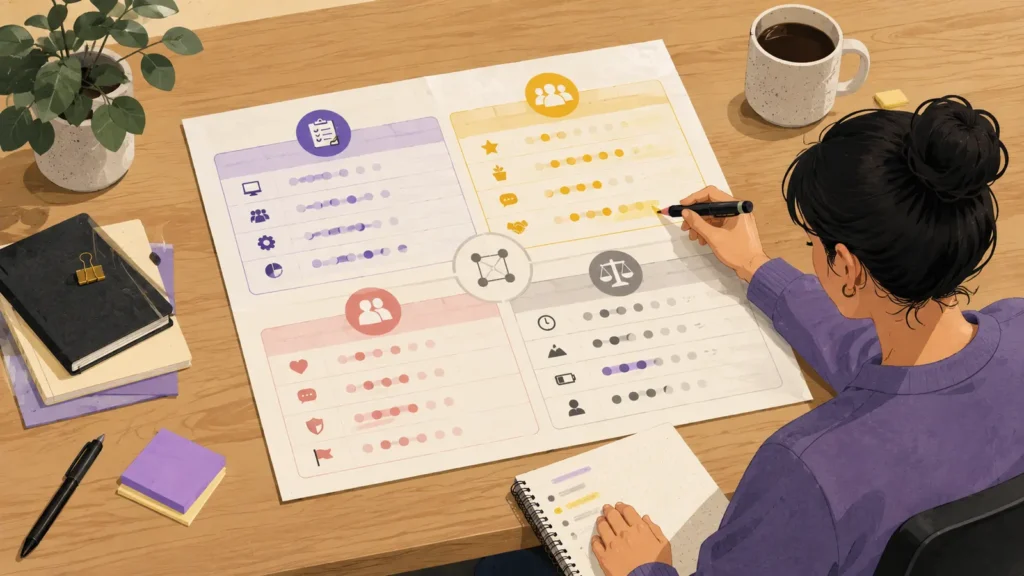
Personality test vs aptitude test for career choice: a personality test explores how you tend to think, behave and prefer to work, while an aptitude test measures how effectively you handle particular kinds of problems or tasks. Neither should choose a career for you. Use personality results to identify environments that may suit you, aptitude results to spot capabilities worth developing, and real-world experience to check whether the work actually fits.
Quick decision rule: Personality asks, “How might I prefer to work?” Aptitude asks, “What kinds of tasks can I learn or perform relatively well?” Career fit asks a third question: “Do I want the real duties, conditions and training this path requires?” A sound choice needs evidence from all three.
Personality test vs aptitude test for career: the key difference
A personality assessment normally uses self-report questions. It may describe tendencies such as sociability, persistence, openness to change, preference for structure or comfort with uncertainty. These clues are useful when comparing work styles and environments. For example, someone who prefers careful, independent concentration may feel better in a different setting from someone who gains energy from constant interaction.
An aptitude assessment usually asks you to solve problems under standard conditions. It may examine verbal, numerical, spatial, abstract, mechanical or perceptual abilities. O*NET distinguishes work styles—personality tendencies shown at work—from abilities that influence performance. That separation is why the two tests answer different questions.
What each test can—and cannot—tell you
Preference clues and performance evidence answer different career questions.
Question
Personality test
Aptitude test
Main focus
Preferences, tendencies and work style
Performance on defined tasks
Typical format
Rate statements about yourself
Solve verbal, numerical, spatial or practical items
Useful for
Comparing environments, roles and collaboration styles
Finding relative strengths and likely learning demands
Cannot prove
That you will enjoy every job linked to a label
That you will value, enjoy or persist in the work
Best next step
Check the result against past behaviour
Check it through projects, classes and practice
A personality result can provide language for patterns you have noticed, but self-perception changes with mood, experience and context. A broad label may also hide important differences between two jobs. “People-oriented,” for example, could mean teaching, persuading, counselling or coordinating. Those activities require different strengths and may feel very different day to day.
An aptitude score is not a fixed ceiling. Familiarity, education, language, tiredness and test conditions may affect performance. A lower score may show a development need rather than a permanent limitation; a higher score does not create motivation. If you solve numerical problems quickly but dislike doing them for long periods, the result should not push you into a numbers-heavy career.
Complete the personality–aptitude comparison chart
Use one row for each career you are seriously considering. Do not copy the assessment’s recommended occupation and stop there. Translate the result into something you can observe.
Personality clue: Write the work condition the result suggests, such as frequent collaboration, independence, variety or clear routines.
Aptitude clue: Record the task area measured and the score’s limitation. Replace “I am bad at maths” with “multi-step numerical reasoning needs more practice.”
Occupation evidence: Research the career’s actual duties, work context, training and entry requirements—not just its title.
Real-world test: Choose a small project, course, interview, job shadow or volunteer task that lets you try the work pattern.
Do not search for perfect agreement. A useful chart may reveal tension: you may prefer independent work but show strong interpersonal aptitude, or enjoy creative environments while scoring highly in numerical reasoning. Mixed evidence expands your options; it does not invalidate the tests.
Worked example: choosing between design and engineering
Imagine Sana is deciding between product design and mechanical engineering. Her personality test suggests curiosity, adaptability and a preference for collaborative projects. Her aptitude results show strong spatial visualisation, average numerical reasoning and careful attention to detail. A weak interpretation would say, “Personality means design; aptitude means engineering.”
A better interpretation turns scores into hypotheses. Both paths may use visual thinking, iteration and teamwork. Sana researches real tasks, speaks with students in both programmes and completes two mini experiments: redesigning an everyday object and building a simple mechanism. She notices that she enjoys generating concepts but also likes testing why a physical system fails. The evidence points toward product development, industrial design or design engineering—not a forced choice based on one label.
A small project can reveal more about fit than another round of quizzes.
Pick one career hypothesis and test it within two weeks. Record what felt engaging, what was difficult, what improved with practice and which work conditions mattered. Review the chart after the experiment. Keep, revise or reject the hypothesis, then set another review after a larger experience such as a course or placement. Tests should start an investigation, not end it.
Frequently asked questions
Which is better for career choice: a personality test or an aptitude test?
Neither is universally better because they measure different things. A personality test can clarify preferred work styles; an aptitude test can provide evidence about particular abilities. Combine both with interests, values, job research and direct experience.
Can an aptitude test tell me what career I will enjoy?
No. Aptitude evidence may show tasks you handle relatively well, but enjoyment also depends on interests, values, people, pace and environment. Try the task in a realistic context before committing.
What if my personality and aptitude results disagree?
Treat the disagreement as a research question. You may have an ability you do not enjoy using, or a preferred field that requires skills you can develop. Examine the specific tasks and conditions, run a small experiment and reassess with evidence.
Build a fuller career-fit picture. Use RoleQuiz to explore personality, interests and strengths, then verify promising directions through real tasks. Take the Study & Career Assessment →
Can a shy person choose a people-focused career? Yes. Shyness does not automatically rule out teaching, counselling, healthcare, human resources, customer success, community work or other careers centred on people. The better question is not whether you feel shy, but which types of interaction you can handle well, enjoy enough to repeat and are willing to practise.
Quick answer: A shy person can succeed in a people-focused career when the role matches their preferred interaction pattern. Test one-to-one conversations, small groups and larger audiences separately. Look for evidence of effectiveness, energy and recovery instead of assuming that quietness means poor people skills.
Shyness is not the same as disliking people
Shyness usually describes hesitation or self-consciousness in social situations, especially when they are new or evaluative. It does not tell you whether you care about others, listen well, communicate clearly or build trust. You may need time to warm up and still find a conversation meaningful once it begins.
It also helps to separate shyness from introversion and social skill. Introversion is often about how much stimulation you prefer and how you recover your energy. Social skills are learned behaviours such as asking useful questions, explaining an idea, reading a room and resolving misunderstandings. A person can be shy yet socially skilled, or outgoing yet ineffective at listening.
Important distinction: Do not use one personality label as a career verdict. Treat “I am shy” as the beginning of an investigation: When does hesitation appear? Which settings make it smaller? What can you already do well with people?
People-focused work is not one level of social demand
A people-focused career can involve very different interaction patterns. A career adviser may spend much of the day in structured one-to-one conversations. A recruiter may switch between interviews, messages and meetings. A teacher interacts with groups, while a user researcher may prepare carefully for a few interviews and then analyse findings alone.
That variety matters because being comfortable in one setting does not guarantee comfort in every setting. You might dislike networking events but enjoy helping one person solve a problem. You may contribute thoughtfully in a small team yet feel drained by constant customer contact. Judge the actual work pattern, not the broad label “works with people.”
What evidence should you collect?
Before choosing or rejecting a career, gather evidence from small real situations. After each interaction, record what happened rather than rating yourself as “good” or “bad.” Focus on these five signals:
Effectiveness: Did the other person understand, feel supported or move forward?
Preparation: Did having questions, an agenda or background information improve your confidence?
Interaction size: Was one-to-one, a small group or a larger audience easier?
Energy: Did the interaction feel meaningful, merely tiring or deeply draining?
Recovery: How much quiet time did you need before you could engage well again?
O*NET describes work styles as personality tendencies shown at work and separates social orientation from qualities such as cooperation, empathy, sincerity and self-confidence. That is useful because enjoying constant social contact is only one part of working effectively with people. A quiet person may bring strong empathy, reliability and thoughtful communication to a role. Explore the official O*NET Work Styles definitions when comparing occupations.
Use a social-demand exposure ladder
The goal is not to force yourself into the hardest situation immediately. Start with a manageable interaction, observe the result and increase the social demand one step at a time. You can stop at the level that reflects the career you are considering.
Build confidence gradually by testing one interaction level at a time.
Level
Small career test
What to notice
1. Prepared contact
Send a question or request a short informational interview
Anticipation, clarity and willingness to continue
2. One-to-one
Tutor, mentor, interview or help one person for 20–30 minutes
Listening, usefulness, energy and recovery
3. Small group
Join a project meeting or facilitate a discussion for three to six people
Turn-taking, contribution and comfort after warming up
4. Visible interaction
Give a brief update, demonstration or workshop segment
Effect of preparation, performance and desire to repeat
Make the test fair: Repeat each level two or three times. The first attempt mostly measures unfamiliarity. Later attempts reveal whether preparation and practice reduce the difficulty enough for the work to be sustainable.
A realistic example
Imagine Sara, a university student who calls herself shy. She is interested in counselling and student support but assumes she cannot choose a people-focused career because she dislikes speaking in class. Instead of treating that reaction as proof, she tests the work pattern.
First, she prepares five questions and interviews a student adviser. Next, she volunteers to guide one new student through an application form. She feels nervous beforehand, but during the conversation she listens closely, notices confusion and explains the steps clearly. She is tired afterward, yet satisfied rather than depleted.
Sara then helps with a small orientation group. She finds spontaneous introductions difficult but becomes comfortable once the discussion has a clear purpose. Her evidence suggests that structured helping conversations may fit better than constant networking or large-group performance. She can now explore roles with that pattern and keep building the skills they require.
People-focused work can reward listening, empathy and careful preparation.
Match the career to your interaction pattern
If one-to-one contact suits you, investigate careers built around advising, interviewing, tutoring, patient support, coaching or specialist client work. If small structured groups feel better, consider training, user research, project coordination or team-based support. If you grow comfortable with visible interaction, teaching, facilitation, leadership or community outreach may become realistic options.
These are starting points, not guarantees. Two jobs with the same title can have very different meeting loads, customer volumes and performance expectations. Read job descriptions, ask professionals how their week is divided and compare the environment as carefully as the occupation.
When shyness needs more than career experimentation
Normal nervousness can improve with preparation, repetition and supportive environments. However, if fear is intense, persistent or stops you from attending interviews, classes, work or everyday activities, career testing alone may not address the problem. Consider speaking with a qualified mental-health professional or another appropriate support service. This article offers career-planning guidance, not a diagnosis.
Frequently asked questions
Can shy people be good leaders?
Yes. Leadership also depends on judgement, preparation, listening, reliability and the ability to give clear direction. A quieter leader may communicate differently from a highly expressive leader while still being effective.
Should a shy person avoid jobs with customers?
Not automatically. Compare structured, predictable contact with continuous high-volume interaction. Try a realistic shift, volunteer task or job shadow before deciding whether the customer-contact pattern is sustainable.
Can people skills improve with practice?
Yes. Skills such as active listening, asking follow-up questions, explaining clearly and speaking to groups can be practised. Improvement does not require changing your entire personality.
Choose with evidence, not a label
A shy person can choose a people-focused career, but the right decision comes from matching the role’s real social demands to your strengths, preferences and capacity for growth. Use the exposure ladder, repeat small tests and keep notes on effectiveness, energy and recovery. Evidence from real interactions will tell you far more than the word “shy.”
Explore your personality–career fit: RoleQuiz helps you turn personality patterns, interests and work preferences into clearer career directions—without treating one trait as your final answer. Explore RoleQuiz.
Direct answer: A useful career personality fit checklist compares your preferred work conditions with the conditions a career actually provides. Check interaction level, autonomy, pace, structure, problem type, sensory environment and feedback style. Treat every preference as a hypothesis, gather evidence from real tasks and conversations, then test the biggest unknown through a small work sample before you commit to a course, degree or job change.
Personality can help you ask better career questions, but it cannot choose a job for you. Two people with the same personality label may want different schedules, tolerate different pressures and enjoy completely different tasks. Even the same occupation can feel different across employers, teams and specialities.
The goal is therefore not to find a career that “matches your type.” It is to identify conditions in which you are more likely to work well, then confirm that those conditions exist in the roles you are considering.
Why a career personality fit checklist is harder than it looks
Most career advice turns personality into a shortcut: introverts should work alone, extroverts should work with people, creative people need unstructured jobs, and organised people need routine. These claims are too broad to guide an expensive decision. A quiet person may enjoy leading a small expert team. A social person may still need several hours of uninterrupted concentration. Someone who loves variety may dislike unpredictable emergencies.
Job titles also hide important differences. A software developer in a small agency may switch between clients and meetings all day, while another developer in a larger organisation may spend long periods on one system. A teacher may work with children, adults, individuals or large classes. Career fit depends on the version of the job you can realistically enter.
A label is a starting clue, not a verdict. Replace “I am an introvert” with a testable statement such as “I do my best thinking after 60–90 minutes without interruption, but I enjoy one purposeful team discussion each day.” Specific conditions can be researched and tested; labels cannot.
What evidence should you collect before scoring fit?
Begin with situations you have actually experienced: classes, internships, paid work, volunteering, group projects, hobbies and family responsibilities. For each situation, record what you did, how the environment operated, your energy during and after the task, and whether your performance improved with practice.
The O*NET work-styles framework offers useful vocabulary for qualities such as attention to detail, cooperation, independence, adaptability and stress tolerance. Use it to expand your questions, not to turn one score into a final career answer.
Interaction: Do you prefer solitary focus, one-to-one contact, a small team or constant public interaction?
Autonomy: Do you want freedom over methods, or clear procedures and close feedback?
Pace: Do you work best with steady deadlines, rapid response or long project cycles?
Structure: How much routine, predictability and advance planning helps you perform?
Problem type: Are you energised by people problems, data, ideas, systems or practical objects?
Stimulation: How do noise, interruptions, travel, physical activity and screen time affect you?
Feedback and conflict: How often do you need feedback, and what level of disagreement can you handle constructively?
Evidence rule: Mark a preference as “confirmed” only when you have seen the pattern in at least two different situations. If the evidence is mixed or based only on imagination, mark it “untested.” This keeps the checklist honest.
Complete the career personality-fit checklist
Choose one career option and complete a row for every condition. Do not score from job descriptions alone. Use occupational profiles, several current job adverts, an informational interview and, where possible, a short realistic task. Different sources reveal different parts of the work.
Fit question
Your evidence
Career evidence
Next test
How much interaction is sustainable?
Examples from study, work or projects
Meetings, clients, teamwork and audience
Observe or simulate a normal interaction block
How much autonomy helps performance?
Response to clear rules versus freedom
Supervision, decision rights and procedures
Complete one task with realistic guidance
What pace supports good work?
Energy under steady and urgent deadlines
Turnaround times, interruptions and workload peaks
Run a timed sample task
How much routine or variety fits?
Reaction to repetition and switching
Recurring tasks versus changing assignments
Map a typical week with a practitioner
Which problems hold attention?
Tasks you voluntarily return to
People, data, ideas, systems or things
Try the most frequent core task
Which trade-off is hardest?
Noise, travel, conflict, uncertainty or screen time
Unavoidable conditions in the role
Test the highest-risk condition first
A checklist becomes useful when every claim is connected to evidence and a practical next test.
Use observations, work samples and conversations to test each fit assumption.
Step 1: Write preferences as testable statements
Replace flattering adjectives with observable conditions. “I am creative” might become “I stay engaged when I can generate several approaches and refine one through feedback.” “I am organised” might become “I perform better when priorities and deadlines are visible.” Each statement should tell you what evidence to seek.
Step 2: Separate ability from sustainability
You can be good at something that drains you. You can also enjoy a condition without yet having the skill to perform well in it. Record performance and energy separately. Strong evidence of fit is repeated competent work that remains reasonably sustainable—not one exciting day or one stressful failure.
Step 3: Look for contradictions
Contradictions make the checklist more accurate. If you usually prefer independence but loved one team project, ask what was different. Perhaps the team was small, roles were clear and meetings were purposeful. The exception may reveal your real condition more precisely than the general rule.
Step 4: Test the risk, not the fantasy
People naturally research the attractive parts of a career. Instead, identify the condition most likely to make the role unsustainable. If you dislike conflict, ask how disagreements are handled. If interruptions exhaust you, investigate the real meeting load. If uncertainty worries you, learn how priorities change during a normal month.
Do not average away a deal-breaker. A career can score well overall and still be unsuitable if one unavoidable condition conflicts with your health, responsibilities or non-negotiable needs. Keep each result visible instead of hiding everything inside one total.
Apply the checklist to a realistic example
Consider Maya, a graduate who describes herself as quiet and analytical. She assumes this means she should avoid collaborative careers and shortlists data analysis because it sounds solitary. Her evidence tells a more useful story: she likes uninterrupted investigation, but she also enjoys presenting a conclusion to a small group when she has time to prepare.
Maya researches two analyst roles. One requires frequent ad-hoc requests, quick client calls and daily priority changes. The other involves longer research cycles, scheduled reviews and written recommendations. The titles are similar, yet the work conditions are different. Her personality label could not reveal that difference.
She speaks with two analysts, completes a short data-cleaning exercise and presents her findings to a friend acting as a manager. The task confirms that she enjoys the problem type. The presentation shows that planned interaction is comfortable, while unexpected questions are tiring but manageable with practice. She keeps the second role on her shortlist and marks rapid client response as a risk to investigate further.
The same person can fit differently depending on pace, interaction, structure and autonomy.
Decide the next action and when to reassess
A checklist should produce an experiment, not a permanent identity. Choose the smallest next action that can change your confidence in the career. Then set a review date so that uncertainty does not turn into endless research.
Today: write five preferred work conditions as specific, testable statements.
Within one week: compare those statements with three job adverts and one detailed occupation profile.
Within two weeks: ask a practitioner to describe an ordinary week, including pressure, interruptions and trade-offs.
Within one month: complete a realistic work sample that includes the condition you are least sure about.
At the review date: mark each condition confirmed, contradicted or still untested, then choose the next evidence step.
Explore your career-fit patterns with RoleQuiz. An assessment can organise clues about interests, strengths and preferred ways of working. Use the result to build a shortlist, then verify it with the evidence process in this guide. Take the RoleQuiz career assessment →
Frequently asked questions
Can a personality test tell me which career to choose?
No single personality test can make that decision. A well-designed assessment may highlight patterns and useful questions, but career choice also depends on tasks, skills, values, constraints, opportunities and the specific environment of a role.
What if my personality changes in different settings?
That is useful evidence, not a problem. Most people respond differently to group size, familiarity, pressure, authority and purpose. Record which conditions change your behaviour and performance instead of forcing yourself into one fixed description.
How many checklist items need to match?
There is no universal passing score. Focus first on non-negotiables and unavoidable conditions. Several minor mismatches may be manageable, while one serious conflict can matter greatly. Use the checklist to expose trade-offs and decide what to test next.
Should I reject a career after one bad experience?
Usually not. One experience may reflect a poor supervisor, an unfamiliar task or an unusual deadline. Look for repeated patterns across settings. If the same condition causes difficulty several times, investigate whether the role can be shaped differently or whether another direction offers a better fit.
Final thought: verify fit before you commit
The best career personality fit checklist does not reduce you to a type. It turns broad preferences into observable work conditions, compares them with the real version of a career and identifies the next low-risk test. Use personality as a source of questions, keep contradictions visible and let repeated evidence determine how far you commit.
Direct answer: The people data ideas or things career interests model describes the kind of work object that naturally holds your attention. People-focused work centres on helping, teaching, persuading or coordinating. Data-focused work involves analysing, measuring and organising information. Ideas-focused work explores concepts, language, design or strategy. Things-focused work involves building, operating, repairing or working with tangible materials. Most people are a blend, so use your top two preferences to generate career families—not to accept a single career verdict.
A career title can hide what a normal day actually feels like. A marketing role may involve people, data and ideas; a healthcare role can combine people, information and practical equipment. That is why asking “Which career matches me?” is often less useful than asking, “What do I want to spend my working hours interacting with?”
This guide gives you a practical mapper for answering that question with real evidence. You will identify your strongest preferences, turn combinations into career families, test a realistic example and choose a next step that is small enough to complete.
What do people, data, ideas and things mean in career planning?
These four categories describe the main object of your effort. They are not measures of intelligence or fixed personality types. One category is not better than another, and preferring one does not mean you are incapable of the others.
Things: building, repairing, operating equipment, handling materials, making prototypes, growing, cooking or working outdoors.
Look at verbs, not job labels. “Engineer,” “teacher” and “designer” are titles. Designing a system, explaining a concept, testing a component and coordinating a team are activities. Activities reveal whether the work involves people, data, ideas or things.
Why this career-interest question is harder than it looks
People often choose the category that sounds most impressive or familiar. They may say they prefer people because they are friendly, even though frequent emotional interaction exhausts them. Someone may reject data because they dislike school mathematics, yet enjoy comparing prices, tracking sports statistics or finding errors in spreadsheets.
Your preference can also change with the setting. You might enjoy working with people one-to-one but dislike large groups. You may like ideas when there is a clear problem, but not when the task is completely open-ended. You may prefer practical things at home while avoiding noisy industrial environments.
Mixed preferences are normal. In fact, combinations are usually more useful than a single result. If you are still separating motivation from ability, read career interests vs skills. To add work-style evidence, use the guide to choosing a career based on personality.
Collect evidence before choosing your strongest preference
Review the last six to twelve months rather than relying on an idealised self-image. Include school, work, volunteering, hobbies, family responsibilities and personal projects. Record moments when you became absorbed, voluntarily continued or felt satisfied after finishing. When a career family looks promising, use the O*NET work-activity descriptors to compare your preference with real occupational tasks.
Attention: Which activities make it easier to concentrate without constant pressure?
Initiative: What do you start, improve or research without being repeatedly reminded?
Satisfaction: Which completed tasks give you a clear sense of useful progress?
Persistence: What kinds of difficulty are you willing to work through?
Energy: Which activities leave you engaged rather than consistently depleted?
Outside evidence: What do teachers, colleagues or friends repeatedly trust you to handle?
Do not score only what feels easy. A meaningful interest can be difficult. The stronger signal is that you want to understand the difficulty, practise and return to the activity after setbacks.
Complete the people-data-ideas-things mapper
Create four columns and write at least three recent examples in each. Then rate every example from 1 to 5 for attention, satisfaction and willingness to repeat. Add the three ratings. Your goal is not to produce a scientific score; it is to make your assumptions visible enough to test.
Analyse a small public dataset and explain one finding
Ideas
Developed a fresh campaign concept and revised it
Design, writing, strategy, product, research
Create a brief, prototype or article for a real audience
Things
Repaired equipment and enjoyed troubleshooting it
Engineering, skilled trades, manufacturing, culinary, field work
Complete a supervised build, repair or practical workshop
Use recent evidence, generate several families, and test one realistic task before committing.
Map recent activities across four preferences, then rank patterns and test your strongest combination.
Step 1: Rank patterns, not isolated moments
One enjoyable afternoon is weak evidence. Look for repeated examples across different situations. If people-related activities score highly only when you already know everyone, your preference may be close one-to-one collaboration rather than constant public interaction. Write that condition beside the score.
Step 2: Use your strongest pair to generate career families
Your top two categories create better hypotheses. People plus ideas may point toward teaching, communications, user research or facilitation. Data plus ideas may suggest analysis, research, strategy or software. Data plus things can lead toward engineering technology, laboratory work, logistics or quality control. People plus things may appear in healthcare, hospitality, coaching, field service or skilled instruction.
Step 3: Filter the families by work environment
A matching work object does not guarantee a matching job. Compare pace, autonomy, routine, teamwork, physical setting, training, income and schedule. If your preferences feel different from last year, the guide on how career interests change over time can help you decide what deserves retesting.
Your preference is a starting hypothesis: “I may prefer ideas and data in a quiet, structured environment.” That statement is useful because you can test it. “I am an ideas person, so I must become a designer” is too narrow and may hide better options.
Apply the mapper to a realistic example
Imagine Amir, a university student who says he wants a career with people because he enjoys helping friends. His evidence shows a more specific pattern. He likes explaining technical concepts to one person, analysing why a process failed and building simple digital tools. Large social events drain him, and persuasive selling feels uncomfortable.
Amir’s scores place ideas first, data second, people third and things fourth. Instead of concluding that he should avoid people, he looks for careers where ideas and data are central while interaction is purposeful. His shortlist includes business analysis, user research, instructional design and product operations.
He tests the options by interviewing a business analyst, analysing survey responses for a student society and creating a short tutorial from the results. The analysis is engaging, but the interview reveals that some roles involve more meetings than expected. Amir does not abandon the direction; he refines it toward research and operations roles with deeper individual work.
A realistic conversation and mini-project can reveal whether a career family fits your preferred work activities.
Decide your next action and when to reassess
Career planning becomes safer when your commitment grows with evidence. Choose the test that answers the biggest remaining question about your preferred combination.
Today: list twelve recent activities and place each under people, data, ideas or things.
Within three days: score attention, satisfaction and willingness to repeat.
Within one week: generate five career families from your strongest pair.
Within two weeks: speak with one person in a shortlisted field and ask what they actually do in a normal week.
Within one month: complete one realistic mini-project, observation, workshop or volunteer task.
On your review date: keep, revise or remove each career hypothesis using the new evidence.
Turn your work preferences into career directions. RoleQuiz can help you organise patterns across interests, abilities and personality. Use the result to create a shortlist, then verify it with conversations and practical tests. Take the RoleQuiz career assessment →
Frequently asked questions
Can I prefer more than one of people, data, ideas or things?
Yes. Most roles combine categories, and many people have two strong preferences. Your combination is usually more useful than trying to force yourself into one box. Also record the conditions in which each preference appears.
Does preferring people mean I should choose a social career?
Not necessarily. You may enjoy advising one person, teaching small groups or collaborating with familiar colleagues while disliking constant networking or emotional pressure. Define the type and amount of interaction you can sustain.
What if my interests and skills point in different directions?
Treat that difference as a development question. You can build a skill that supports a strong interest, or use an existing skill in a more interesting setting. Compare motivation, learning speed and real opportunities before deciding.
Can these career interests change over time?
Yes. Experience, responsibility, confidence and exposure can change what you enjoy. Reassess after a new course, project, job or major life change. The purpose is to guide the next decision, not permanently label you.
Final thought: use the four preferences to explore, not restrict
The people data ideas or things career interests framework is useful because it turns a vague career question into observable work activities. Collect recent evidence, identify your strongest pair, generate several career families and test the daily reality. You do not need one perfect category or one permanent answer. You need a promising direction and the next piece of evidence.
If you are looking for signs your personality does not fit your job, focus on repeated patterns rather than one difficult week. You may feel consistently drained by the job’s core tasks, social demands, pace, rules or level of uncertainty—even when the workload is reasonable and your manager is supportive. But similar feelings can also come from a poor culture, unclear leadership or temporary overload. Before changing careers, compare four areas: the tasks, workplace culture, manager relationship and workload. The source of the mismatch tells you whether to adjust the role, change employers or explore a different career direction.
Quick answer: A personality–job mismatch is more likely when the same core work conditions drain you across different teams and reasonable workloads. Test the pattern for two weeks before making a major decision.
Why job mismatch is difficult to diagnose
A bad day can make any job feel wrong. A stressful deadline can make an otherwise suitable role feel unbearable. The opposite is also true: a friendly team can temporarily hide the fact that the core work never suits you. That is why feelings alone are not enough. You need to identify which condition creates the problem and whether it changes when the condition changes.
Personality is not a label that permanently assigns you to one career. It is a pattern of tendencies—such as your preference for social interaction, structure, novelty, independence or calm focus. O*NET describes work styles as personality tendencies shown at work and includes factors such as social orientation, adaptability, attention to detail and stress tolerance. These are useful comparison points, not final verdicts. Explore O*NET work styles.
7 signs your personality does not fit your job
You recover from the people, not the work. Meetings, networking or constant collaboration leave you depleted, even when the conversations go well.
You rarely use your natural working style. You prefer careful analysis but must decide instantly, or you enjoy experimentation but must follow rigid procedures all day.
Competence does not create engagement. You can perform the core tasks, yet doing them repeatedly feels flat rather than satisfying.
You must constantly perform a work persona. Professional adaptation is normal, but continuous masking feels exhausting and prevents honest contribution.
The environment fights your concentration. Noise, interruption, ambiguity or isolation repeatedly blocks the conditions in which you do your best work.
The mismatch follows you across managers. Similar problems appear in different teams because they are built into the occupation’s everyday demands.
You envy how other roles work. Your attention is drawn less to another job title and more to its pace, autonomy, collaboration or problem type.
Important: These signs do not prove that you chose the wrong career. Burnout, unfair treatment, disability barriers, poor management and personal stress can produce similar experiences. Diagnose the work conditions before blaming your personality.
Complete the person–environment mismatch audit
For ten working days, score each area from 1 (strong mismatch) to 5 (strong fit). Add one observable example instead of writing only a feeling.
Tasks: Did the actual work use your preferred way of thinking, communicating and solving problems?
Culture: Did the team’s pace, norms, values and social expectations help or hinder you?
Manager: Were expectations, feedback, trust and decision rights clear enough for you to work well?
Workload: Was the volume sustainable, or would almost any role feel wrong under this pressure?
Score tasks, culture, manager and workload separately to locate the real source of mismatch.
After two weeks, calculate the average for each area. If tasks stay low while culture, manager and workload score reasonably well, investigate role or career fit. If tasks score well but culture or manager remains low, the same occupation at another employer may feel very different. If workload is the only low score, test recovery, boundaries and resourcing before making a career-level conclusion.
A realistic example
Maya works as a marketing analyst and assumes she chose the wrong field because she feels exhausted every evening. Her ten-day audit shows task fit at 4, culture at 2, manager at 4 and workload at 3. She likes finding patterns in campaign data, but her open office, constant interruptions and meeting-heavy culture prevent deep work.
Instead of abandoning marketing analytics, Maya asks for two protected focus blocks and tests a quieter work location. She also interviews an analyst at a more research-oriented company. Her energy improves when the environment changes. The evidence points to a workplace mismatch, not proof that her personality is incompatible with the occupation.
Useful distinction: Do not ask only, “Can I do this job?” Ask, “Under what conditions can I do this work well and sustainably?”
The same work can feel very different when the environment changes.
Choose the smallest useful next step
Match your action to the evidence. For a task mismatch, shadow a related role or complete a realistic work sample. For a culture mismatch, compare the same role in another organisation. For a manager mismatch, clarify expectations or explore an internal move. For overload, reduce pressure where possible and reassess after recovery.
Does feeling tired mean my personality does not fit my job?
No. Tiredness can come from workload, health, poor sleep, stress or a difficult environment. Look for a repeated connection between specific core job demands and your energy before concluding there is a personality mismatch.
Can I adapt to a job that does not naturally suit me?
Often, yes. Skills, routines and confidence can change. The key question is whether adaptation becomes sustainable or requires continuous strain with little benefit. Run a small adjustment before deciding.
Should a personality test decide whether I leave?
No. A test can suggest patterns to investigate, but it cannot observe your manager, workload, workplace or daily tasks. Combine assessment results with the audit, real examples and low-risk experiments.
Ready to explore your patterns? Use RoleQuiz to identify possible personality and career-fit patterns, then verify them with evidence from your real work.
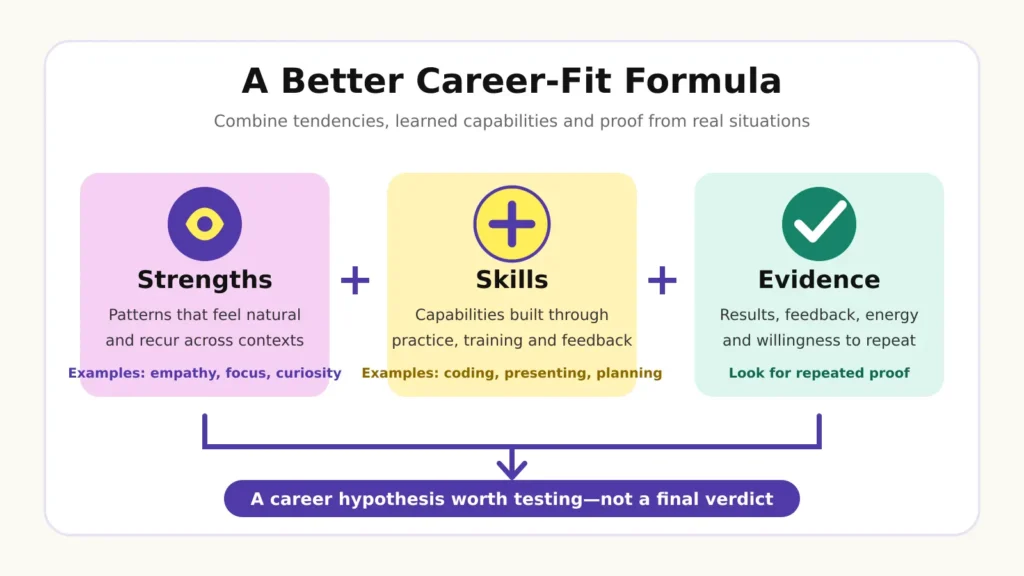
In strengths vs skills career planning, the difference is simple: a strength is a recurring way you tend to think, respond or perform well, while a skill is a capability you have learned through practice, education or experience. Neither should choose a career for you. Strengths help you generate promising directions; skills show what you can currently do; real evidence shows whether the combination works in a particular environment.
Quick answer: Do not ask whether strengths or skills matter more. List your recurring strengths, name the skills that make each strength useful, and collect examples of results, feedback, energy and willingness to repeat the task. Use the strongest combinations to create two or three career hypotheses, then test one before making a larger commitment.
Strengths vs skills in career planning: the short answer
The terms overlap in everyday speech, which is why they create confusion. A person might call communication a strength because explaining ideas feels natural, or a skill because they learned presentation structure and audience research. Both descriptions can be correct. The useful distinction is not the label itself; it is what the label helps you decide.
A strength is a pattern that appears repeatedly across situations. Examples may include noticing inconsistencies, staying calm with frustrated people, seeing how parts connect, generating alternatives or bringing structure to a vague task. A skill is an observable capability, such as analysing a spreadsheet, writing a brief, conducting an interview, using design software or coordinating a project timeline.
O*NET separates occupation information into areas such as skills, abilities, work activities and work styles. Its skills framework is useful for researching what different roles require. Your personal examples are still essential, because a database can describe a job but cannot tell you whether you want to practise its central tasks.
A practical rule: A strength without a supporting skill may remain potential. A skill without interest, energy or suitable conditions may remain useful but draining. Career fit becomes clearer when a recurring tendency, a developed capability and evidence from real tasks point in the same direction.
Use this strengths-versus-skills comparison table
Complete the table with your own evidence rather than selecting flattering words. For each possible strength or skill, ask what happened, what you actually did, what changed and whether other people noticed the contribution.
Career-planning question
Strength
Skill
Evidence to collect
What is it?
A recurring tendency or capacity that often feels natural
A capability developed through learning and practice
Specific situations, actions, results and feedback
Can it change?
It can become more visible, refined or context-dependent
It can usually improve with deliberate practice
Compare performance over several months
What does it predict?
Tasks or conditions that may feel more intuitive or energising
Tasks you can currently perform to a useful standard
Whether you perform well and want to repeat the work
What can it miss?
Training requirements, opportunity and actual job conditions
Motivation, values, energy and preferred environment
Constraints, entry routes and the frustrating parts of work
How should you use it?
Generate career hypotheses
Assess readiness and development gaps
Run a small test before a major commitment
Use strengths and skills together, then verify both with repeated real-world evidence.
Combine strengths, skills and repeated evidence to create a career hypothesis worth testing.
What strengths can—and cannot—tell you
Strengths help you notice patterns that are easy to overlook because they feel ordinary. You may assume everyone can calm a tense group, spot the missing step in a plan or translate complex information into plain language. Repeated examples suggest that the behaviour is worth exploring further.
Look for the pattern in at least three different settings, such as study, work, volunteering, hobbies or family responsibilities.
Separate the action from the outcome. “The event succeeded” is vague; “I reorganised the schedule when a supplier was late” shows what you contributed.
Track energy after the task. Performing well once does not prove that you want the activity to dominate your working week.
Ask for specific feedback: “When have you seen me make a difficult task easier?” produces better evidence than “What are my strengths?”
A strength cannot tell you that a particular occupation is automatically suitable. The same tendency may appear in very different careers. Careful listening could support counselling, user research, healthcare, teaching or customer success. You still need to compare the daily tasks, work environment, qualifications, schedule and trade-offs.
What skills can—and cannot—tell you
Skills are valuable because they are learnable and observable. You can improve them through instruction, deliberate practice, feedback and repeated use. This means a promising career should not be rejected simply because you are a beginner. A current gap may be a development plan, not proof of poor fit.
Technical skills include capabilities tied to tools, methods or specialist knowledge.
Transferable skills—such as analysis, communication, planning and problem solving—can be useful across industries.
Context changes the skill. Presenting to five classmates is different from briefing senior leaders or teaching a nervous client.
Proficiency needs proof: a completed project, measurable result, portfolio sample, assessment, reference or reliable feedback.
Do not confuse competence with fit. You may be skilled at a task because circumstances required years of practice, yet find it exhausting. You may also enjoy a field but dislike one necessary activity. Treat both reactions as data: redesign the role, develop the weak skill, or test a different environment before ruling out an entire career.
Build your own strength–skill–evidence map
Choose five experiences from the last twelve months. Include at least one difficult experience, because strengths often become visible when plans change. For each experience, write one line under these headings:
Situation: What needed to be achieved or improved?
Strength: Which recurring tendency helped you respond?
Skill: What learned capability did you use?
Evidence: What result, output or feedback shows the contribution?
Energy: Did you want to repeat or improve the task after it ended?
Context: Which people, pace, structure and level of autonomy helped you perform?
Then circle combinations that appear in three or more experiences. “Curiosity + interviewing + strong follow-up questions” is more useful than “good with people.” “Pattern recognition + spreadsheet analysis + error reduction” is more useful than “good at maths.” Specific combinations can be matched to real work activities.
Your map should produce hypotheses, not a permanent identity. Write, “I may fit work that combines investigation, explanation and regular contact with people.” Do not jump straight to, “I must become a psychologist.” One pattern can support several career directions, and each direction deserves a practical test.
A realistic example: one strength, several possible careers
Imagine Aisha, a recent graduate, describes herself as organised and good at communication. Those labels are too broad. She reviews a research project, a volunteer event and a part-time retail role. Across all three, she notices the same pattern: when information is scattered and people are uncertain, she asks clarifying questions, creates a simple structure and explains the next steps.
Her likely strengths are sense-making, calm communication and follow-through. Her demonstrated skills include interviewing, writing concise instructions, maintaining a task tracker and presenting updates. The evidence includes fewer missed deadlines, positive teammate feedback and customers needing fewer repeated explanations.
This combination could support project coordination, customer education, user research, operations or community programmes. It does not prove that one of those careers is right. Aisha compares their daily tasks and chooses two tests: she creates an onboarding guide for a volunteer group and interviews a project coordinator about deadlines, conflict and routine administration.
After four weeks, she reviews performance, energy and the parts she disliked. That review is more informative than choosing a title from the words “organised communicator.”
Turn the comparison into a career decision
Real tasks, feedback and repeated practice turn strengths and skills into useful career evidence.
Name two or three career hypotheses. Match the repeated strength–skill combinations to occupations where those activities are central.
Check the real work. Read current job descriptions and occupation profiles, then ask a practitioner what they did last week.
Identify one development gap. Choose a skill that can be practised in a small project rather than enrolling in a major programme immediately.
Run a representative test. Complete a short project, volunteer task, job shadow, portfolio exercise or structured conversation.
Review on a specific date. Compare results, feedback, energy, constraints and desire to improve before deciding the next step.
Set your review date now. Choose a date four to six weeks away and define what evidence you will bring: one completed task, feedback from two people, notes from a practitioner conversation and a short energy log. A review date prevents endless self-analysis while keeping the decision reversible.
Common mistakes when comparing strengths and skills
Treating “natural” as fixed and assuming strengths never develop.
Choosing only from skills you already possess and ignoring learnable gaps.
Using positive feedback without checking whether the task is sustainable.
Selecting a career from a broad label instead of its recurring daily activities.
Letting one quiz score overrule experience, constraints or current occupation research.
Collecting evidence forever without choosing a test and review date.
It can be both. Ease with reading people or explaining ideas may be a strength; active listening, presentation structure, negotiation and clear writing are skills developed through practice. Use examples to identify which part is repeated and supported by results.
Should I choose a career based on strengths or skills?
Use strengths to generate promising directions and skills to assess current readiness. Then test the combination against interests, values, work conditions, qualifications and real evidence. Neither list should make the decision alone.
Can a weakness become a skill?
Yes. A task that is currently difficult can improve through instruction and deliberate practice. Decide whether the skill is essential, whether the development cost is realistic and whether you want to use it often enough to justify the effort.
How many examples prove a strength?
There is no magic number, but three specific examples from different contexts are stronger than one memorable success. Look for repeated actions, reliable results, outside feedback and a willingness to use or improve the capability again.
Turn your evidence into clearer career directions. Take the RoleQuiz Study & Career Assessment, then compare the result with your strengths–skills map and one real-world experiment. Use the assessment as a starting hypothesis—not a final verdict.
If you are wondering how to choose a career based on your personality, do not begin by matching a four-letter label to a list of jobs. Start with the work conditions in which your behaviour is most sustainable: how much interaction you enjoy, how you handle structure and change, how you make decisions, and what kind of pressure you can manage. Then compare those preferences with the real daily tasks of several careers and test the strongest options through small experiences.
Quick answer: Use personality as a filter for work conditions, not as a rule about job titles. Identify five behavioural preferences, find evidence from past tasks, research how different roles are actually performed, and run a small test before committing. The best direction is one where personality, interests, strengths, values and practical constraints work together.
Personality can guide a career choice—but it cannot make the decision
Personality describes relatively consistent patterns in how you tend to think, respond and behave. It may help explain why one environment feels natural while another demands constant self-management. However, it does not determine what you can learn, what you value or which occupation you must enter. An outgoing person can enjoy analytical work. A quiet person can become an excellent teacher, leader or adviser. Context, skill, motivation and experience change how a trait appears.
This distinction matters because many career guides turn personality into stereotypes: “introverts should code” or “extroverts should sell.” Real occupations are broader than those labels. Two people with the same title may have very different schedules, teams, managers, customers and levels of autonomy. The useful question is not “Which career belongs to my type?” It is “Which conditions help me do good work repeatedly?”
Avoid the stereotype trap: A preference is not a prohibition. Preferring focused work does not mean avoiding people; it may mean choosing deeper one-to-one interaction over constant interruption. Enjoying collaboration does not mean you cannot handle independent tasks.
Five personality dimensions that affect work fit
1. Interaction and social energy
Notice the amount and kind of interaction you can sustain. Some people think best alone and enjoy planned conversations. Others gain momentum through frequent discussion. Many prefer a mixture. Record whether meetings sharpen or scatter your attention, whether one-to-one conversations feel different from large groups, and how much recovery time you need after public-facing work.
2. Structure and flexibility
Structure includes rules, routines, deadlines and clarity about the correct process. You may perform well when expectations are explicit, or you may feel constrained unless you can design your own method. Neither pattern is superior. The goal is to know how much structure supports you before it becomes restrictive—and how much freedom motivates you before it becomes confusing.
3. Pace, novelty and change
Some people like predictable cycles because repetition helps them deepen skill. Others need new problems, changing priorities or rapid feedback. Be specific: perhaps you enjoy variety in subject matter but prefer a stable schedule, or enjoy a fast pace only when priorities remain clear. Those combinations are more useful than calling yourself “adventurous” or “routine-oriented.”
4. Autonomy and decision-making
Consider how comfortable you are making decisions, influencing others and taking responsibility when information is incomplete. You may want ownership of a defined area without managing people. You may enjoy guiding a team but dislike competitive persuasion. Separate leadership, independence, influence and risk tolerance instead of treating them as one trait.
5. Focus, pressure and emotional load
Workplaces differ in noise, interruption, conflict, urgency and emotional intensity. A person can be caring yet find continuous crisis work exhausting. Another may stay calm during emergencies but struggle with slow, detail-heavy administration. Sustainable fit depends on what you can handle repeatedly, not what you survived once.
The official O*NET work-styles framework offers useful language for comparing occupations, including adaptability, cooperation, attention to detail, social orientation, stress tolerance, initiative and intellectual curiosity. Treat these descriptors as research prompts rather than a verdict about your identity.
Build a personality-to-work-condition map
Use the map below to turn broad personality impressions into observable questions. Complete it with examples from school, university, volunteering, hobbies, part-time jobs and personal projects. Strong evidence appears in several settings, not only one unusually good or bad day.
Work condition
Questions to ask yourself
Evidence to collect
Interaction
How much conversation helps you think? Do you prefer one-to-one, small groups or frequent public contact?
Energy and focus after solo, pair and group tasks
Structure
Do clear rules help you perform, or do you need freedom to shape the method?
Quality and stress under detailed instructions versus open briefs
Pace and change
Do you prefer predictable cycles or rapidly changing priorities?
Performance during routine weeks and fast-moving projects
Autonomy
How often do you want to make decisions without approval?
Motivation with close guidance versus independent ownership
Ambiguity
Can you move forward before every answer is known?
Response to unclear problems, experiments and changing information
Emotional and sensory load
How much conflict, noise, interruption or emotional intensity can you sustain?
Recovery time and concentration in different settings
Personality-to-work-condition map: translate broad traits into conditions you can observe and test.
The map is useful when it changes what you investigate. “I am an introvert” is too broad. “I concentrate best with two uninterrupted hours, then enjoy a planned client conversation” is a work-condition hypothesis that you can compare with real roles.
How to collect personality evidence instead of guessing
Memory is selective, so create a simple evidence log for two weeks. After a meaningful task, record what the task required, the environment, your energy before and after, the quality of your work, and whether you would willingly repeat it. Include tasks you disliked as well as tasks you enjoyed. The contrast often reveals the condition that mattered.
Name the behaviour. Write “asked clarifying questions,” “organized the plan,” or “worked quietly for ninety minutes,” not “acted like my type.”
Separate task from setting. You may dislike a presentation because of poor preparation, not because communication is a bad fit.
Look for repeatability. One successful event is encouraging; the same pattern across several contexts is stronger evidence.
Ask for outside observations. A classmate, colleague or supervisor may notice how you contribute when a group is uncertain or under pressure.
Track the cost. Good performance can still be unsustainable if it requires long recovery after every ordinary workday.
Collect evidence across different tasks before deciding which work conditions suit you.
Match the map to occupations, not stereotypes
Next, research three to five occupations that satisfy your strongest conditions. Do not stop at job descriptions or glamorous summaries. Look at daily tasks, work context, level of contact with others, decision authority, deadlines, physical setting and common sources of pressure. O*NET occupation profiles can help you compare work styles and activities, while conversations with people in the field reveal how the same role varies by employer.
For example, “marketing” can mean solitary analysis, client presentations, content production, campaign coordination or fast-moving agency work. “Software” can involve deep individual focus, pair programming, stakeholder meetings, incident response or team leadership. Personality fit usually exists at the intersection of role, organization, manager and working arrangement—not in the title alone.
A realistic example: choosing between appealing career options
Imagine Aisha, a graduate who describes herself as quiet, creative and organized. A stereotype-based list points her toward solitary design work. Her evidence log tells a more useful story. She enjoys focused research, becomes energized in one-to-one interviews, contributes thoughtful ideas in small groups, and performs poorly when priorities change without explanation. She likes creativity, but she also wants a clear problem and deadline.
Aisha compares graphic design, user research and product operations. Instead of asking which title suits a “quiet creative,” she maps the conditions. Graphic design offers focused creation but varies widely in feedback and deadline pressure. User research combines preparation, interviews, analysis and communication. Product operations offers structure and coordination but may involve frequent interruptions.
She tests each hypothesis: completes a small design brief, conducts two practice interviews and helps coordinate a student project. The interviews require social effort, yet she finishes curious and alert. The coordination work is satisfying when responsibilities are clear but draining when messages arrive constantly. Her next step is not a lifelong verdict; it is a provisional decision to explore user research and structured research-operations roles more deeply.
Notice what changed: Aisha did not choose by identity label. She compared conditions, gathered behavioural evidence and reduced uncertainty with representative tasks.
Test the work conditions before you commit
A small test is more informative than another hour of personality content. Choose an experience that reproduces a meaningful part of the work and its environment. A short course is useful only if you complete the assignments. An informational interview is useful when you ask what the person did yesterday, what interrupts their work and which tasks create pressure.
Shadow or interview someone in the role and ask about pace, interaction, autonomy and feedback.
Complete a realistic beginner project with a deadline and review.
Volunteer for a task that includes the environment you want to test.
Try both a collaborative and an independent version of a similar activity.
After each test, compare energy, performance, stress, curiosity and willingness to repeat it.
Small experiments reveal which work conditions are sustainable for your personality.
Set a review date before the experiment begins. At that point, keep, revise or reject the hypothesis. Rejecting an option is progress because it prevents a larger commitment based on fantasy.
What personality should not decide on its own
Even a strong personality match is incomplete. A career must also fit your interests, strengths, values, financial needs, access to training, health, responsibilities and the opportunities available where you plan to work. Someone may enjoy a fast social environment but value predictable hours. Another may love independent analysis but need frequent mentoring while building competence.
A career personality assessment can organize your observations and suggest language you have not considered. Use the result as a set of hypotheses. Highlight statements supported by real examples, question statements that depend on one context, and research careers because of their tasks and environments—not because a report says they are ideal.
Do not treat one score as permanent or precise.
Do not reject a career solely because it is absent from a suggested list.
Compare results with interests, strengths, values and constraints.
Repeat important conclusions through real-world evidence.
Choose a next experiment, not an identity.
When several sources agree—your behaviour, trusted feedback, occupational research and a realistic test—you have a stronger basis for action. When they disagree, investigate the contradiction. It may reveal that you like a task but not its usual environment, or that confidence is still developing.
Frequently asked questions
Can a personality test tell me which career to choose?
No single test should make the choice for you. A well-designed assessment can reveal patterns and suggest careers to research, but it cannot know every work environment, constraint or future skill. Use the result to create hypotheses, then verify them with occupational research and real tasks.
Should introverts avoid careers that involve people?
No. Introversion does not mean disliking people or lacking communication ability. You may prefer planned, meaningful or one-to-one interaction rather than constant group contact. Research the type, frequency and intensity of interaction within a role instead of judging it by title.
What if my personality changes in different situations?
That is normal. Behaviour is influenced by confidence, stress, culture, familiarity and the people around you. Look for patterns across several contexts and describe the conditions that produce your best work. A flexible map is more accurate than forcing one permanent label.
Is personality more important than skills or interests?
No. Personality, skills and interests answer different questions. Personality helps describe how you prefer to work; skills show what you can do; interests show what holds your attention. Career choice also requires values, constraints and opportunity. Strong decisions combine all of them.
How many careers should I compare?
Begin with three to five plausible options. That range creates useful contrast without producing an overwhelming list. Compare their real tasks and conditions, test the best two or three, and set a date to review your evidence.
Choose your next evidence-gathering step
Learning how to choose a career based on your personality is not about finding a job reserved for your type. It is about understanding the conditions in which you can contribute, learn and recover sustainably. Build your map, compare several real occupations and choose one small test you can complete in the next two weeks.
Explore your personality and career-fit patterns with RoleQuiz. Use the guidance and assessment resources to generate career hypotheses, then compare them with your work-condition map and real-world evidence. Explore RoleQuiz career guidance →
If you want to know how to use communication strengths in career choice, begin by separating “good communication” into specific behaviours. Writing clearly, explaining ideas, persuading, listening and facilitating are different strengths, and each becomes valuable in different work settings. Collect examples of when your communication improved an outcome, notice which mode gives you energy, then compare careers by their daily communication demands. Use this evidence to create two or three career hypotheses and test them before making a major commitment.
Quick answer: Build a five-part communication profile covering writing, explaining, persuading, listening and facilitating. For each mode, record evidence, energy, preferred audience and working conditions. Then research roles where your strongest two modes are used regularly. A communication strength should guide the next career test—not decide your future by itself.
Why “I am a good communicator” is not specific enough
Communication is often treated as one broad soft skill. In practice, a person can write excellent reports but dislike live presentations. Someone who is persuasive in a one-to-one conversation may feel drained by constant networking. A careful listener may be excellent at uncovering customer needs without enjoying a high-volume customer-service environment.
The setting changes the meaning of the strength. Explaining a science concept to a student is different from presenting quarterly results to executives. Facilitating a calm workshop is different from mediating a conflict. Before you connect communication ability to a career, identify what you communicate, to whom, through which channel and under what pressure.
Avoid the job-title shortcut. Communication appears in healthcare, engineering, education, research, technology, operations, sales, public service and creative work. Do not limit yourself to careers with “communications” in the title. Compare the actual tasks and context.
Separate your five communication strengths
The official O*NET skills framework distinguishes abilities such as writing, speaking and active listening, while its broader skill profiles show that occupations use different combinations. The five-part profile below translates those distinctions into practical career evidence.
1. Writing: making ideas clear without being present
Writing strength is not only good grammar. It includes choosing the right detail, organizing information and adapting the message to the reader. Useful evidence might include a guide that reduced questions, a report that helped a group decide or feedback that your instructions were easy to follow. Careers to investigate include technical writing, policy work, content design, research and documentation.
2. Explaining: helping someone understand or act
Explaining means translating complexity into a structure another person can use. Look for moments when a customer understood a process after your demonstration or a team moved forward because you clarified the issue. This strength appears in teaching, learning design, healthcare, product support and leadership. Check whether you prefer one-to-one explanations, groups or visual demonstrations.
3. Persuading: influencing a decision ethically
Persuasion combines audience awareness, credible reasoning and a clear request. Evidence might include winning support for an event or presenting a proposal that received funding. It is useful in sales, fundraising, advocacy, recruitment and management. Distinguish thoughtful influence from aggressive pressure; the style you can sustain matters.
4. Listening: discovering what is not obvious
Strong listening is active work. It involves asking useful questions, noticing uncertainty and checking your understanding. Evidence could come from resolving a misunderstanding or identifying a hidden need. Listening supports counselling, user research, healthcare, human resources, customer success and technical work that requires careful requirements gathering.
5. Facilitating: helping a group make progress
Facilitation means guiding a conversation without controlling every idea. You keep the purpose visible, invite quieter voices and move the group toward a decision. Evidence may come from leading a study group, coordinating volunteers or running a workshop. Project management, community work, operations and training often use this strength.
Separate communication into specific modes before connecting it to a career.
Collect evidence before choosing a direction
A strength is more convincing when it appears across different situations. Review school, volunteering, hobbies, paid work, personal projects and community activities. For every communication example, write down the audience, purpose, difficulty, action and result. “People say I communicate well” is weak evidence. “I redesigned the volunteer instructions and new members completed setup with fewer questions” is specific and testable.
Outcome: What became clearer, faster, calmer or more persuasive because of your communication?
Repeatability: Has this happened in at least three different situations?
Energy: Did the activity leave you satisfied, neutral or depleted?
Feedback: What did other people specifically say or ask you to do again?
Conditions: Did you work best with preparation, live interaction, a small group, a written channel or time pressure?
Growth: Are you willing to practise the weaker parts required by the role?
Evidence rule: Keep a strength on your profile when you can describe a real behaviour and outcome. Keep it as a hypothesis when it is based only on preference, praise or an assessment result. Both are useful, but they should not carry equal weight.
Complete your communication-strength profile
Copy this table into a document or notebook. Complete one row for each communication mode. The goal is not to give every strength a high score. The goal is to see which combinations are supported by evidence and which conditions make them sustainable.
Communication mode
Your evidence
Best conditions
Career test
Writing
What did you make clearer?
Long-form, concise, technical or creative?
Write a guide, brief or article.
Explaining
Who understood or acted?
One-to-one, group, visual or verbal?
Teach a short lesson or demo.
Persuading
Which decision changed?
Consultative, public or negotiation?
Pitch a real proposal ethically.
Listening
What hidden need emerged?
Interview, support or advisory?
Run two structured interviews.
Facilitating
How did a group progress?
Planning, conflict or workshop?
Guide a 30-minute discussion.
Add two final columns if useful: an energy score from 1–5 and an evidence score from 1–5. A high ability score with low energy may indicate something you can do but do not want as a major part of your day. A high energy score with weak evidence suggests a promising area to practise and test.
Apply the profile to a realistic example
Imagine Aisha, a recent graduate who describes herself as a people person. Her evidence shows something more precise. She wrote clear onboarding notes for a student society, helped new members explain their concerns and guided meetings when the group became stuck. She received strong feedback for listening, explaining and facilitating. She disliked competitive debates and felt drained when she had to make repeated cold pitches.
Aisha does not conclude that every people-focused career will suit her. She creates three hypotheses: customer education, user research and learning coordination. All three use her strongest modes, but the audience, pace and purpose differ. She reads occupation descriptions, studies real job adverts and asks professionals how much of the week is spent interviewing, presenting, documenting and coordinating.
Next, she runs low-risk tests. She interviews two users for a community project, creates a ten-minute tutorial and facilitates one volunteer planning session. After each activity, she records the outcome, energy, frustration and desire to improve. The tests give her better evidence than simply choosing “marketing” or “HR” because those jobs sound social.
Ask professionals how communication is used during an ordinary workday—not only whether they enjoy the career.
Match the strength to the work context
How often is this communication mode used during a normal week?
Is the audience one person, a team, the public or senior decision-makers?
How much preparation is available before communicating?
Is the purpose to inform, teach, investigate, support, negotiate or sell?
How much conflict, emotional intensity or rejection is typical?
Does the role also fit your interests, values, constraints and preferred work environment?
Better career question: Replace “Which jobs are good for communicators?” with “Which roles repeatedly use my strongest communication modes, with an audience and level of pressure I can sustain?” That question produces much better options.
Choose two or three careers to test
Use your top two communication modes as search criteria, not as a final answer. If writing and explaining are strongest, explore technical documentation, learning design, content design or policy communication. If listening and facilitating stand out, investigate user research, advising, community development, human resources or project coordination. Then compare the non-communication tasks that fill the rest of each role.
Week 1 — Profile: Gather five to ten examples and score evidence, energy and preferred conditions.
Week 2 — Research: Compare three roles using O*NET descriptions, real job adverts and ordinary daily tasks.
Week 3 — Conversations: Interview two professionals. Ask what they wrote, explained, listened to or facilitated yesterday.
Week 4 — Practice: Complete one representative project and request specific feedback on the outcome.
Review: Keep, revise or reject each career hypothesis. Choose the next experiment and a date to reassess.
Frequently asked questions
What careers are good for people with strong communication skills?
Many careers use communication, including education, healthcare, user research, technical writing, customer success, consulting, sales, public service, project management and human resources. The better match depends on whether your evidence is strongest in writing, explaining, persuading, listening or facilitating—and on the audience and pressure you prefer.
Can an introvert have strong communication skills?
Yes. Communication quality is not the same as sociability. An introvert may be an excellent writer, prepared presenter, careful interviewer or calm facilitator. Evaluate observable behaviours and outcomes instead of using personality labels as limits.
Should communication skills be the main factor in career choice?
No single strength should decide a career. Combine communication evidence with interests, values, preferred environment, practical constraints, training requirements and the rest of the daily work. Use the strength to narrow and test options.
How can I prove communication skills without work experience?
Use examples from school projects, volunteering, clubs, community activities, online collaborations and personal projects. Create fresh evidence by writing a guide, teaching a short lesson, interviewing users or facilitating a meeting. Record the outcome and request specific feedback.
Explore your strengths with RoleQuiz. Use the Study & Career Assessment to identify possible strength, interest and work-style patterns. Treat the report as a source of career hypotheses, then verify those ideas with your communication profile and real-world tests. Start the RoleQuiz assessment →
Quick answer: If you are asking how to choose a career if you prefer quiet work, start by defining the conditions that help you concentrate—not by searching for a list of “introvert jobs.” Measure how much uninterrupted time, interaction, noise, collaboration and feedback you can sustainably handle. Then compare real workplaces and test promising roles before committing.
Preferring quiet, focused work does not mean you dislike people, cannot collaborate or must work alone all day. You may enjoy one-to-one conversations, thoughtful written communication or a small team while finding constant interruptions and performative socialising exhausting. That distinction matters because the same job title can feel completely different in two organisations.
This guide turns a broad preference into a quiet-work compatibility checklist. You will identify the interaction pattern you can sustain, investigate actual work conditions and test career options with evidence instead of personality stereotypes.
Why choosing a quiet-work career is harder than it looks
Career lists often label occupations as “quiet” without showing the daily reality. A software developer may get long concentration blocks in one company and spend much of the day in meetings in another. A librarian may work behind the scenes with collections or spend hours helping the public. Remote work can reduce office noise while increasing video calls and chat interruptions.
Quiet is also not one condition. You might need low noise but still want frequent written contact. You may prefer a small familiar team, yet dislike presenting to strangers. Or you may tolerate a busy setting when the task is absorbing and your schedule is predictable.
A better rule: Choose for the pattern of work, not the stereotype of the worker. The useful question is not “Am I introverted?” It is “Which combination of focus, interaction, autonomy, pace and sensory load helps me produce good work repeatedly?”
How to choose a career if you prefer quiet work
Use four stages: define what “quiet” means to you, score your compatibility needs, investigate occupations at the workplace level, and run small tests. The aim is not to eliminate every social demand. It is to find a balance where interaction is purposeful and enough protected focus remains for you to do your best work.
1. Identify the interaction you can sustain
Review the last six months of study, volunteering, projects or paid work. Find situations where you concentrated well and situations where your energy dropped. Record what was happening before you label yourself. Look for the frequency, duration and type of interaction.
Written interaction: email, documentation, research notes, reports or asynchronous messages.
One-to-one contact: interviews, advising, tutoring, client calls or feedback conversations.
Small-team collaboration: planning, reviewing work and solving a defined problem together.
Large-group demands: presentations, networking, facilitation or serving a continuous flow of people.
Unplanned contact: interruptions, urgent requests and spontaneous changes in priority.
Rate each pattern from 1 to 5 for energy after the activity, quality of performance and recovery time. Separate discomfort caused by inexperience from a genuine preference. A presentation may become easier with practice; a day of nonstop interruption may remain draining even when you are skilled.
2. Complete the quiet-work compatibility checklist
Use the table below for three real situations: one where you worked well, one that drained you and one that felt balanced. Evidence from your behaviour is more reliable than guessing how a job might feel.
Compatibility factor
Question to answer
Your evidence
Focus duration
How long can you work well before useful interaction helps?
Examples from study, projects or work
Interaction type
Do you prefer written, one-to-one, small-team or public communication?
Interactions that energised or drained you
Interruption level
How often can priorities change without harming your performance?
What happened in busy versus protected time
Sensory setting
Which noise, movement and privacy conditions support concentration?
Places where you consistently did good work
Feedback rhythm
Do you want continuous feedback or scheduled review points?
How you improved fastest without feeling watched
Schedule
Do predictable blocks or varied days suit you better?
Your energy patterns across a typical week
How to score it: Give every factor an importance score from 1 to 5 and a minimum acceptable condition. For example: “I need at least two uninterrupted 90-minute blocks on most days,” or “I am comfortable with three planned meetings but not constant walk-up requests.” Specific thresholds make job research much easier.
Compare the type, frequency and amount of interaction you can sustain before evaluating career titles.
3. Research the work environment, not only the occupation
Start with occupation databases to understand tasks, work styles and context. O*NET explains that work styles are personality tendencies expressed at work and provides occupation-level information. Its work-style pages include social orientation, attention to detail and other tendencies. Use its work-context data to investigate contact with others, teamwork, noise and time pressure. Then use the Occupational Outlook Handbook to verify duties, education, work environment and outlook.
Possible starting points include technical writing, data analysis, software development, editing, accounting, laboratory work, drafting, translation, archiving and research. These are hypotheses, not guarantees. Every field contains different employers, teams and specialisations.
Read several job advertisements and count meeting, client-facing, presentation and collaboration requirements.
Ask a practitioner to describe yesterday hour by hour instead of asking whether the job is “quiet.”
Compare a large organisation, a small firm, government, consultancy and self-employment within the same field.
Check whether deep work is protected by policy or merely promised during recruitment.
Create a low-cost simulation that resembles the core tasks and communication pattern. Do not test only the enjoyable headline activity. Include deadlines, revision, feedback and a realistic amount of collaboration.
Task sample: complete a two- to four-hour analysis, editing, coding, design or research project.
Communication sample: explain your result in writing and discuss it in a planned one-to-one review.
Environment sample: repeat the task in a library, home workspace, quiet office or coworking space.
Reality conversation: interview someone in the role about meetings, interruptions and the busiest week of the year.
Short exposure: volunteer, shadow, freelance or take a project-based course using realistic tools.
After each test, score concentration, task enjoyment, communication comfort, recovery time and willingness to improve. A good option does not need perfect scores. It needs a sustainable overall pattern and manageable trade-offs.
Worked example: from “I want a quiet job” to useful criteria
Sam’s evidence
Sam studies well in 90-minute blocks, enjoys written feedback and one-to-one problem solving, and works comfortably with a small familiar team. Large presentations are manageable occasionally, but constant customer contact causes mistakes and exhaustion. Sam’s checklist prioritises protected focus, low walk-up interruption, scheduled collaboration and a calm sensory environment.
Instead of assuming one job title is perfect, Sam compares technical writing, data analysis and laboratory quality work. Practitioner interviews reveal that one technical-writing team has daily meetings, while another uses mostly asynchronous reviews. The employer and workflow matter as much as the occupation.
Sam chooses a small technical-documentation project and a beginner data-analysis project, then requests structured feedback on both. The next decision is based on task evidence and work conditions, not on a label such as “quiet person.”
A quiet-work preference can include purposeful one-to-one collaboration without constant interruption.
Questions to ask in an interview or workplace visit
How many hours a typical day are available for uninterrupted work?
How many meetings are recurring, and which are optional?
How are urgent requests handled without interrupting everyone?
Is communication mainly live, written or asynchronous?
Where does focused work happen, and can employees control noise?
How often does the role present to groups, handle customers or switch priorities?
How is performance reviewed: continuous monitoring or scheduled feedback?
Ask for examples rather than accepting general answers such as “we are collaborative” or “you will have autonomy.” A realistic weekly calendar, recent project or description of a busy period provides stronger evidence.
Common mistakes to avoid
Choosing only from “introvert career” lists: they ignore employer, team and specialisation differences.
Confusing quiet with easy: focused jobs may still involve pressure, complexity and accountability.
Avoiding every social demand: communication is part of most careers and can be purposeful without being constant.
Assuming remote work guarantees focus: messages, calls and home conditions can create a different kind of interruption.
Letting one assessment decide: use results to generate questions, then verify them through research and experience.
Frequently asked questions
What careers are good if I prefer quiet work?
Research, data, writing, technical, laboratory, accounting, design and records-focused roles can offer substantial concentration time, but no title guarantees a quiet environment. Compare the actual tasks, team practices, customer contact and interruption level for each employer.
Does preferring quiet work mean I should work alone?
No. Many people who value focus also enjoy scheduled collaboration, one-to-one conversations and small teams. The goal is an interaction pattern that supports performance rather than constant isolation.
Can an introvert succeed in a people-focused career?
Yes. Social preference, shyness and communication skill are different. A person may enjoy meaningful client or student contact while needing recovery time and fewer unplanned interactions. Test the specific demands rather than accepting a personality stereotype.
How can I tell whether a workplace really supports deep focus?
Ask about calendars, meeting hours, response-time expectations, seating, quiet rooms, interruption rules and recent busy periods. Speak with someone doing the job and request concrete examples of a typical day.
Find work conditions that fit how you focus
RoleQuiz can help you organise your personality, interests and work preferences into career directions worth investigating. Use the checklist in this guide to verify each direction with real evidence.
Teamwork vs independent work career choice is not about deciding whether you are a “team person” or a “solo person.” Most jobs contain both. The useful question is how much collaboration, ownership and feedback you need to produce good work without becoming drained or disconnected. Compare the actual rhythm of a role, score your preferences, and test your result in a real setting before choosing a career direction.
Quick answer: choose team-oriented work if frequent discussion, shared decisions and fast feedback improve your energy and performance. Choose more independent work if uninterrupted focus, personal ownership and control over your process help you do your best. If both sound right, look for a blended role with planned collaboration and protected focus time.
Teamwork vs Independent Work Career Choice: Define the Real Decision
“Teamwork” can mean a daily project meeting, constant customer contact, pair work, or simply coordinating handoffs. “Independent work” can mean owning a project while checking in weekly—not working alone all day. Job titles are therefore unreliable shortcuts. A software developer may spend long periods coding independently but design features with a team. A teacher leads a classroom, plans lessons alone and coordinates with colleagues and families.
Start by separating three dimensions: collaboration frequency, decision ownership and feedback needs. You may enjoy solving problems with others yet prefer to own the final output. Or you may like independent preparation but want frequent review. That combination is more informative than a broad personality label.
What Team-Oriented Work Can and Cannot Provide
Team-oriented environments can create momentum. Ideas are challenged quickly, knowledge is shared, and difficult tasks feel less isolated. They often suit people who think aloud, enjoy coordinating contributions and recover energy through useful interaction. A strong team also gives context: you can see how your part affects a larger result.
Team-oriented work can provide fast feedback, shared problem-solving and social energy.
However, teamwork does not guarantee belonging or support. Poorly run teams may create meeting overload, unclear responsibility, slow consensus and constant interruption. If you choose a “collaborative” career, investigate how decisions are made, how conflict is handled and whether individuals still receive focused time. The quality of collaboration matters more than the number of people in the room.
What Independent Work Can and Cannot Provide
Independent work can offer concentration, autonomy and a clear link between effort and outcome. It may suit people who prefer to think before responding, organise their own process and take responsibility for a complete piece of work. Writers, analysts, technicians, researchers and many craftspeople often have substantial solo task time—even when their work ultimately serves a team or client.
Independent work can offer concentration, personal ownership and control over the process.
But independence is not the same as freedom from accountability. Solo-heavy roles can still involve deadlines, clients and reviews. They may also provide less immediate feedback, fewer spontaneous ideas and greater responsibility when you are stuck. If you need regular reassurance or social contact, too much isolation can reduce motivation. Ask how often you will interact, not merely whether the job is described as independent.
O*NET describes work styles as personality tendencies shown at work and lists cooperation and social orientation among interpersonal work-style factors. Use those ideas as research clues, not as a final verdict: the same occupation can feel very different across employers, teams and role levels. Explore the O*NET Work Styles database alongside real job conversations.
Complete the Team-versus-Solo Work Scorecard
Rate each statement from 1 (strongly independent) to 5 (strongly team-oriented). Answer for a normal week, not an unusually social or stressful day.
Dimension
1: Independent end
5: Team end
Energy
Long focus periods restore me
Useful interaction restores me
Problem-solving
I think best before discussing
I think best by discussing
Decisions
I prefer clear personal authority
I prefer shared decisions
Feedback
Scheduled reviews are enough
I want frequent feedback
Ownership
I want a complete deliverable
I want responsibility distributed
Pace
I prefer controlling my sequence
I enjoy coordinating a shared pace
Conflict
Repeated negotiation drains me
Constructive debate improves my work
Interpret the total carefully: 7–16 suggests an independent lean, 17–25 suggests a blended preference, and 26–35 suggests a team lean. The total is only a hypothesis. Circle any item that matters more than the others. A score of 3 on energy and 5 on feedback may point to quiet work with frequent one-to-one review—not a meeting-heavy workplace.
Work Through a Realistic Example
Imagine Aisha is choosing between junior UX research, content design and account management. She enjoys interviews and workshops, but she needs quiet time to analyse information. Her score is 22: blended. Energy and pace lean independent, while feedback and problem-solving lean toward teamwork.
Instead of concluding that all three careers fit equally, Aisha investigates the weekly pattern. Account management involves frequent live coordination and rapid responses. Content design offers longer production blocks with scheduled reviews. UX research alternates interviews, collaborative planning and independent synthesis. She speaks to people in each role and tries a small research project with classmates.
The experiment shows that Aisha likes purposeful collaboration but becomes tired when communication controls the whole day. She keeps UX research and content design on her shortlist, then looks for employers that protect focus time. Her decision comes from a preferred work pattern, not a stereotype about being introverted or extroverted.
Test the Preference Before You Commit
A scorecard becomes useful when it leads to evidence. During the next two weeks, run one team task and one independent task that are similar in difficulty. After each, record your concentration, energy, quality, stress and desire to repeat the work. Also notice what caused the reaction. A poor team experience may reflect unclear leadership, while a frustrating solo task may reflect missing instructions rather than a true preference.
Ask a professional what percentage of a normal week is spent in meetings, shared production and solo execution.
Request examples of how decisions, feedback and responsibility actually work.
Try a group project, volunteer shift, job shadow or short freelance task.
Review your notes on a set date instead of judging from one mood or one experience.
A career assessment can organise patterns in your social energy, decision style and preferred level of autonomy. It cannot observe every manager, workflow or team culture. Use the RoleQuiz Study & Career Assessment to generate possible career-fit patterns, then confirm them with the scorecard, occupation research and real-world tests.
Frequently Asked Questions
Is teamwork better than independent work?
Neither is universally better. Teamwork can improve idea-sharing and support; independent work can improve focus and ownership. The better environment is the one that matches the task and lets you perform sustainably.
Can introverts succeed in team-based careers?
Yes. Introversion does not mean poor teamwork. Many introverts prefer prepared discussions, smaller groups and protected recovery time. Evaluate the interaction pattern rather than the label.
What if I enjoy both teamwork and working alone?
That is common. Look for blended roles with clear individual responsibilities, scheduled collaboration and uninterrupted focus blocks. Ask employers how a typical week is structured.
Should one preference decide my career?
No. Balance it with interests, skills, values, income needs, training requirements and opportunity. Treat your preference as one important condition of fit, then reassess it after real experience.