
Direct answer: A career strengths worksheet for students should turn ordinary experiences into proof. List moments from coursework, group projects, clubs, sport, volunteering, hobbies and responsibilities at home. For each one, record the task, the action you took, the result and any specific feedback. Strengths that appear across several situations are more credible than labels chosen because they sound impressive.
You do not need years of paid work to understand what you may be good at. Student life already contains deadlines, difficult conversations, research, creative decisions, teamwork and unexpected problems. The challenge is learning to describe that evidence clearly enough to guide career exploration.
Why identifying strengths without work experience feels difficult
Students often compare themselves with professionals and conclude that they have no strengths because they have not held a formal job. That confuses experience with evidence. Employment can provide evidence, but it is not the only place where abilities appear. Completing a demanding assignment, tutoring a classmate, coordinating a society event or caring for a family member can reveal real patterns of communication, planning, judgement and persistence.
Another problem is vague language. Words such as creative, smart or good with people are too broad for career planning. A useful strength statement describes behaviour: simplifying technical information, spotting inconsistencies, generating several solutions, calming disagreement or keeping a team on schedule.
Use evidence before labels: Write what you did and what changed first. Name the possible strength afterwards. This order reduces guesswork and gives you examples you can later use in applications and interviews.
What evidence should students collect?
Start with activities you can verify. The O*NET essential-skills framework offers useful language for abilities used across occupations, while the NACE career-readiness competencies show how communication, critical thinking, teamwork, leadership, professionalism and technology can be demonstrated in different ways. Use these frameworks to name patterns, not to produce a final verdict about your future.
- Coursework: research, presentations, laboratory work, essays, design briefs and difficult topics you learned.
- Group assignments: planning, resolving disagreements, checking quality, explaining ideas and meeting deadlines.
- Extracurricular activities: clubs, sport, competitions, student government, events and creative projects.
- Volunteering and community work: supporting people, organising resources, teaching, fundraising or solving practical problems.
- Home responsibilities: budgeting, caregiving, translating, arranging appointments, repairs or coordinating family tasks.
- Independent interests: coding, gaming communities, content creation, crafts, reading, fitness plans or small business experiments.
Aim for six to ten experiences from at least three areas. A pattern seen in coursework, a club and home responsibilities is more useful than a strength claimed from one unusually good day. If you need a broader starting point, read how to choose a career based on your strengths.

How to use this career strengths worksheet for students
Copy the table into a notebook or document and complete one row for each experience. Keep the description factual. You are building a small evidence file, not writing a personal statement yet.
| Experience | Action you took | Result or feedback | Possible strength | Confidence |
|---|---|---|---|---|
| Group research project | Turned scattered notes into a clear structure and assigned deadlines | Submitted early; teammates reused the plan | Organisation and synthesis | Medium |
| Helping a classmate | Explained a difficult formula using a visual example | They completed the next question independently | Teaching and communication | Medium |
| Student-club event | Compared suppliers and negotiated a lower price | Stayed within budget | Research and negotiation | Medium |
| Personal project | Found why a simple website was loading slowly and fixed it | Load time improved; repeated the method later | Diagnosis and persistence | High |
Step 1: Describe the situation
Choose a specific moment rather than a whole subject or activity. “Biology class” is too broad. “Designed a clear method for our enzyme experiment when the instructions were confusing” gives you something you can analyse.
Step 2: Isolate your action
Separate what the team did from what you personally contributed. Use a strong verb: analysed, designed, explained, coordinated, persuaded, repaired, compared, supported, improved or checked. If you cannot identify your action, do not assign yourself a strength yet.
Step 3: Record a result or outside signal
Results do not have to be awards. Finishing on time, reducing confusion, improving accuracy, helping someone learn or being asked to repeat a responsibility all count. Specific feedback is stronger than general praise. “Your explanation made the process easy to follow” is more useful than “good job.”
Step 4: Look for repeated patterns
Group similar actions. You may discover that presenting, tutoring and writing instructions all involve making complex information understandable. That repeated activity suggests a communication strength. You may also notice the conditions that matter: perhaps you explain well after preparation but dislike improvising in front of a large crowd.
Confidence rule: Mark a strength as high confidence only when you have at least three examples from two different settings. Keep one-example strengths as hypotheses to test.
Apply the worksheet to a realistic student example
Aisha is a second-year student with no formal employment history. She initially writes that she is “organised and helpful,” but those labels do not show how she might contribute at work. She reviews her last year and finds four useful experiences.
In a group assignment, Aisha created a timeline after the team missed its first deadline. In a student society, she compared venue options and kept expenses within budget. At home, she organised medical appointments for a relative and prepared a simple document so everyone understood the schedule. In class, she often turns long readings into concise notes that friends request before exams.
The pattern is not merely “organisation.” Her repeated activities are structuring information, coordinating dependencies and making plans easier for other people to follow. She records planning, information synthesis and follow-through as medium-to-high-confidence strengths. She also notes that she prefers defined goals and small teams to constant public interaction.
Aisha does not jump to one job title. She creates several career hypotheses: project coordination, operations support, research administration and content operations. Then she compares the actual tasks in each role. This is safer than assuming that one strength points to one perfect career.
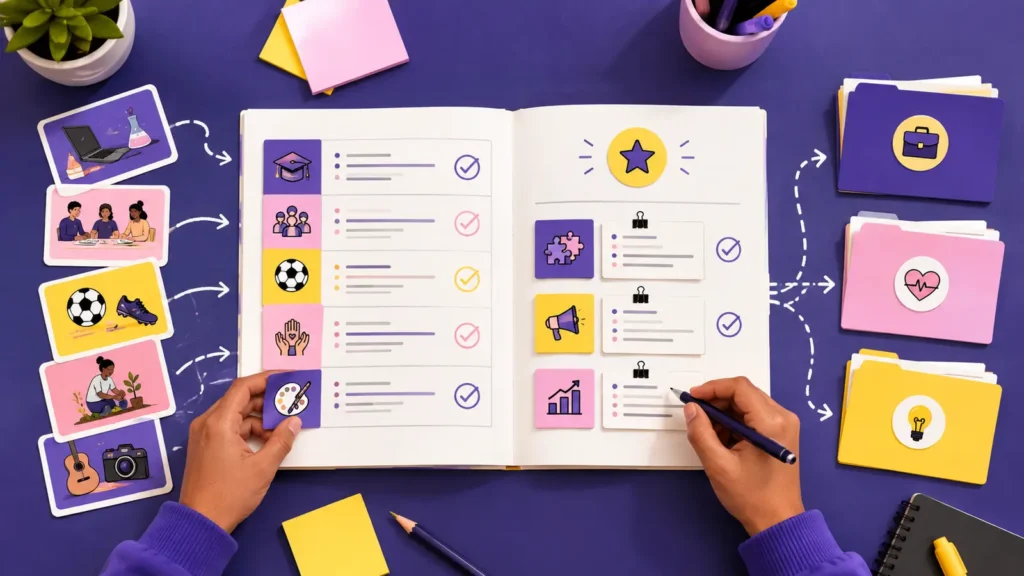
Turn strength patterns into career hypotheses
Translate each strength into work activities, then search for occupations that use those activities in different environments. If your evidence shows that you clarify information, possible directions might include teaching, technical writing, customer education, policy communication or healthcare guidance. The best option depends on your interests, values, constraints and preferred working conditions.
- Write the repeated activity as a verb: explain, investigate, organise, build, care, persuade or improve.
- Find three career directions that use the activity in different industries or environments.
- Check ordinary tasks, training requirements and working conditions rather than relying on the title.
- Choose one low-risk test for each promising direction: a sample project, interview, short course, volunteer task or job shadow.
If you are unsure whether an example represents a learned capability or a broader tendency, the guide to career interests versus skills can help you separate different signals. When many options still seem plausible, use the career choice checklist for undecided people to compare practical fit.
Choose the next action and set a reassessment date
Your worksheet should end with an experiment, not a permanent declaration. Choose the strength-career connection with the strongest evidence and the biggest unanswered question. Then design a small action that can challenge your assumption.
- Within 48 hours: complete at least six worksheet rows.
- Within one week: ask two people for one specific example of when you were effective.
- Within two weeks: research three roles using O*NET task and skills information.
- Within one month: complete one realistic task or conversation connected to the strongest hypothesis.
- On your review date: keep, revise or remove each claimed strength according to the new evidence.
Turn your evidence into career directions. RoleQuiz can help you organise patterns across strengths, interests and personality. Treat the result as a shortlist for research, then confirm it with real experiences. Take the RoleQuiz career assessment →
Frequently asked questions
What strengths can a student have without work experience?
Students can demonstrate communication, analysis, teamwork, planning, creativity, leadership, reliability, technology use, learning speed and problem-solving through academic and non-work experiences. The important part is having a specific example and result for each claim.
Should I include weaknesses in a career strengths worksheet?
You can record development areas, but do not treat every imperfect skill as a weakness. Note which capabilities a possible career requires, your current evidence and whether you are willing to practise. A gap is often a learning question, not proof that a direction is wrong.
How many examples prove a strength?
There is no universal number, but three examples from at least two settings is a sensible confidence rule. Repetition reduces the chance that one result came from luck, unusually strong support or an easy task.
Can a career quiz identify my strengths?
A quiz can suggest language and patterns worth investigating. It cannot observe everything you have done or guarantee that you will enjoy using a strength every day. Combine assessment results with worksheet evidence, feedback and low-risk career experiments.
Final thought: student experience is still experience
A career strengths worksheet for students is useful when it replaces vague self-description with observable proof. Review coursework, teamwork, extracurriculars and responsibilities; record your actions and results; look for repetition; then test how those strengths appear in real occupations. You do not need a long CV to begin. You need honest evidence and a sensible next experiment.