
If you are looking for signs your personality does not fit your job, focus on repeated patterns rather than one difficult week. You may feel consistently drained by the job’s core tasks, social demands, pace, rules or level of uncertainty—even when the workload is reasonable and your manager is supportive. But similar feelings can also come from a poor culture, unclear leadership or temporary overload. Before changing careers, compare four areas: the tasks, workplace culture, manager relationship and workload. The source of the mismatch tells you whether to adjust the role, change employers or explore a different career direction.
Quick answer: A personality–job mismatch is more likely when the same core work conditions drain you across different teams and reasonable workloads. Test the pattern for two weeks before making a major decision.
Why job mismatch is difficult to diagnose
A bad day can make any job feel wrong. A stressful deadline can make an otherwise suitable role feel unbearable. The opposite is also true: a friendly team can temporarily hide the fact that the core work never suits you. That is why feelings alone are not enough. You need to identify which condition creates the problem and whether it changes when the condition changes.
Personality is not a label that permanently assigns you to one career. It is a pattern of tendencies—such as your preference for social interaction, structure, novelty, independence or calm focus. O*NET describes work styles as personality tendencies shown at work and includes factors such as social orientation, adaptability, attention to detail and stress tolerance. These are useful comparison points, not final verdicts. Explore O*NET work styles.
7 signs your personality does not fit your job
- You recover from the people, not the work. Meetings, networking or constant collaboration leave you depleted, even when the conversations go well.
- You rarely use your natural working style. You prefer careful analysis but must decide instantly, or you enjoy experimentation but must follow rigid procedures all day.
- Competence does not create engagement. You can perform the core tasks, yet doing them repeatedly feels flat rather than satisfying.
- You must constantly perform a work persona. Professional adaptation is normal, but continuous masking feels exhausting and prevents honest contribution.
- The environment fights your concentration. Noise, interruption, ambiguity or isolation repeatedly blocks the conditions in which you do your best work.
- The mismatch follows you across managers. Similar problems appear in different teams because they are built into the occupation’s everyday demands.
- You envy how other roles work. Your attention is drawn less to another job title and more to its pace, autonomy, collaboration or problem type.
Important: These signs do not prove that you chose the wrong career. Burnout, unfair treatment, disability barriers, poor management and personal stress can produce similar experiences. Diagnose the work conditions before blaming your personality.
Complete the person–environment mismatch audit
For ten working days, score each area from 1 (strong mismatch) to 5 (strong fit). Add one observable example instead of writing only a feeling.
- Tasks: Did the actual work use your preferred way of thinking, communicating and solving problems?
- Culture: Did the team’s pace, norms, values and social expectations help or hinder you?
- Manager: Were expectations, feedback, trust and decision rights clear enough for you to work well?
- Workload: Was the volume sustainable, or would almost any role feel wrong under this pressure?
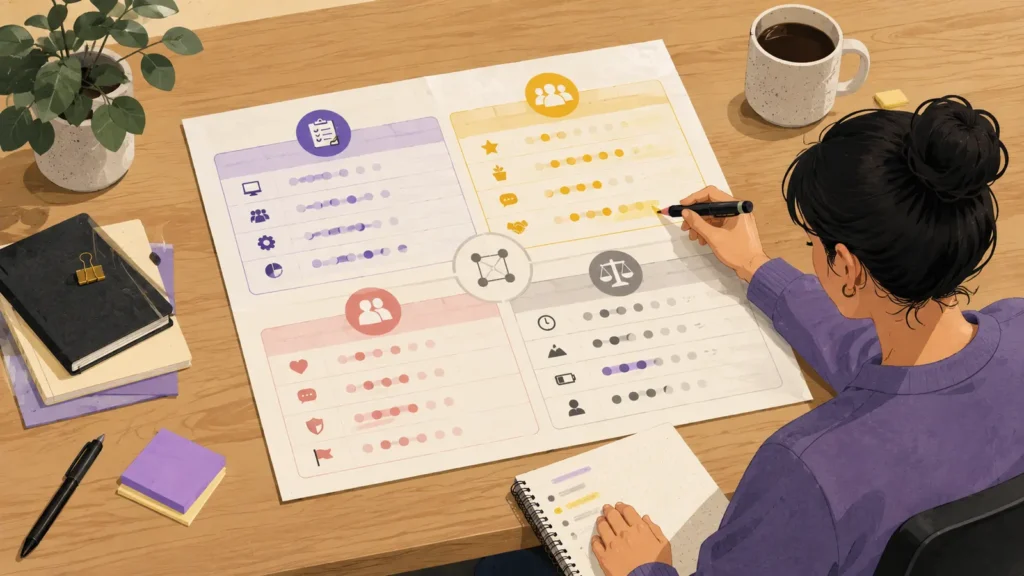
After two weeks, calculate the average for each area. If tasks stay low while culture, manager and workload score reasonably well, investigate role or career fit. If tasks score well but culture or manager remains low, the same occupation at another employer may feel very different. If workload is the only low score, test recovery, boundaries and resourcing before making a career-level conclusion.
A realistic example
Maya works as a marketing analyst and assumes she chose the wrong field because she feels exhausted every evening. Her ten-day audit shows task fit at 4, culture at 2, manager at 4 and workload at 3. She likes finding patterns in campaign data, but her open office, constant interruptions and meeting-heavy culture prevent deep work.
Instead of abandoning marketing analytics, Maya asks for two protected focus blocks and tests a quieter work location. She also interviews an analyst at a more research-oriented company. Her energy improves when the environment changes. The evidence points to a workplace mismatch, not proof that her personality is incompatible with the occupation.
Useful distinction: Do not ask only, “Can I do this job?” Ask, “Under what conditions can I do this work well and sustainably?”

Choose the smallest useful next step
Match your action to the evidence. For a task mismatch, shadow a related role or complete a realistic work sample. For a culture mismatch, compare the same role in another organisation. For a manager mismatch, clarify expectations or explore an internal move. For overload, reduce pressure where possible and reassess after recovery.
Review the result in 14 to 30 days. You can also learn how to choose a career based on your personality without stereotypes, compare whether you prefer working with people, data, ideas or things, and explore options for quiet, focused work.
Frequently asked questions
Does feeling tired mean my personality does not fit my job?
No. Tiredness can come from workload, health, poor sleep, stress or a difficult environment. Look for a repeated connection between specific core job demands and your energy before concluding there is a personality mismatch.
Can I adapt to a job that does not naturally suit me?
Often, yes. Skills, routines and confidence can change. The key question is whether adaptation becomes sustainable or requires continuous strain with little benefit. Run a small adjustment before deciding.
Should a personality test decide whether I leave?
No. A test can suggest patterns to investigate, but it cannot observe your manager, workload, workplace or daily tasks. Combine assessment results with the audit, real examples and low-risk experiments.
Ready to explore your patterns? Use RoleQuiz to identify possible personality and career-fit patterns, then verify them with evidence from your real work.
Leave a Reply