
Direct answer: A useful career transition plan template turns a possible new direction into a sequence of testable milestones. Each milestone should have an action, deadline, proof of progress and an evidence gate that decides whether you continue, revise or pause. Add financial boundaries and fallback routes before making an irreversible move. The plan should help you learn—not force you to defend a career idea that evidence no longer supports.
A career change can feel like one enormous decision: stay or leave, retrain or apply, protect stability or pursue better fit. That framing creates pressure because it asks you to commit before you have enough information. A transition plan breaks the decision into smaller commitments that produce evidence along the way.
This guide is for working adults who have a possible direction but need a realistic route from idea to first move. It combines skills evidence, role research, experiments, milestones, financial limits and fallback plans. A career assessment may help generate hypotheses, but no quiz result should be treated as permission to resign, pay for lengthy training or assume one occupation is your final answer.
Why a career transition plan is difficult to build
Most plans fail at one of two extremes. Some are too vague—“learn new skills, network and apply”—so there is no way to judge progress. Others are over-engineered twelve-month schedules built on assumptions that have not been tested. Both approaches can keep you busy without making the transition safer or more credible.
A good plan separates facts from hypotheses. Your current income, available time and completed projects are facts. Believing you will enjoy a new role, qualify after one course or accept a lower salary are hypotheses. Hypotheses need evidence gates before the plan moves to a more expensive stage.
Plan the next commitment, not your entire identity. A transition plan is a working document. It should become more specific as you collect evidence and simpler when an option proves weak.
The evidence to collect before setting milestones
Start with a target role or a narrow family of roles. “Something creative” is too broad for a useful plan. “Content designer in a software company” or “operations analyst in healthcare” can be researched through occupation profiles, job advertisements and conversations with practitioners.
- Task evidence: the ordinary weekly activities, not only the most attractive projects.
- Entry evidence: required experience, credentials, portfolio expectations and realistic bridge roles.
- Skills evidence: abilities you have already demonstrated and gaps that repeatedly appear in real vacancies.
- Environment evidence: pace, autonomy, teamwork, schedule, location, physical demands and common pressures.
- Market evidence: local demand, salary range, competition and whether entry routes match your circumstances.
- Personal evidence: energy, interest and performance during representative tasks—not only enthusiasm while reading about the role.
Use O*NET skills information to translate your experience into portable capabilities and compare how those skills appear across occupations. The BLS Occupation Finder lets U.S. readers compare education, on-the-job training, pay and outlook. Career changers can also use CareerOneStop’s career-change resources. Use equivalent official labour-market sources where you live because entry rules and pay vary by country and region.
If your direction is still too broad, first work through how to change careers when you do not know what to do. The template below works best once you have at least one option worth testing.
Complete the career transition plan template
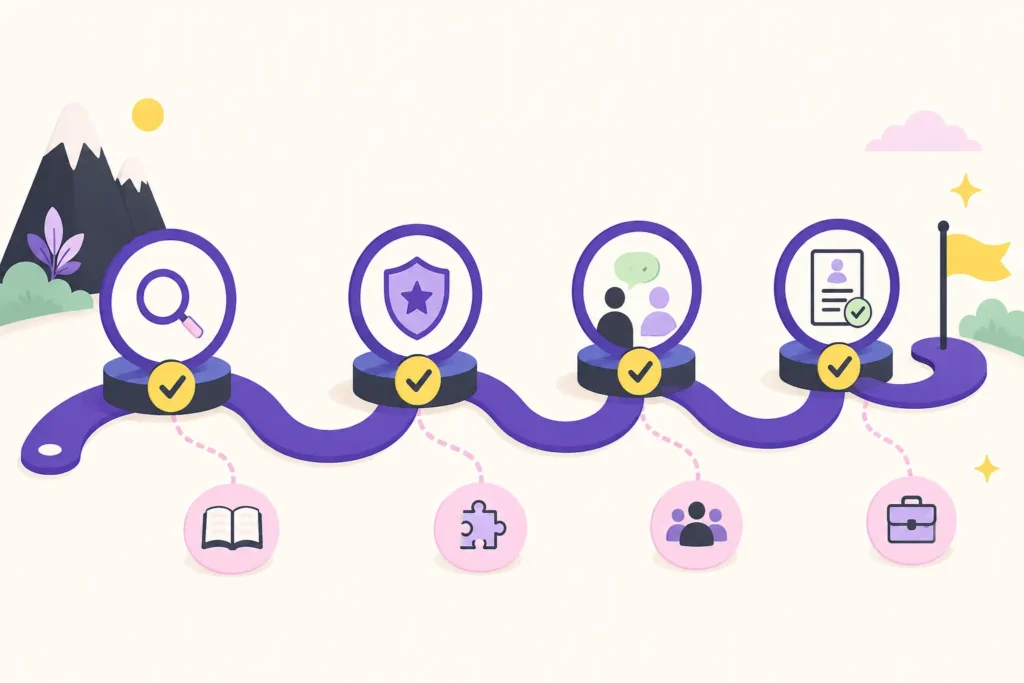
Copy these seven sections into a document or spreadsheet. Write short, observable statements. Review the plan every two to four weeks and after any major evidence gate.
1. Define the possible direction and the reason for testing it
Name the target role, industry and environment as precisely as your current evidence allows. Then write why it is worth exploring using evidence from past work. Avoid relying on prestige, a single exciting conversation or an idealised job description.
- Target direction: role, industry and preferred setting.
- Evidence already supporting the direction: tasks, results, strengths and values.
- Most important uncertainty: the question that could change your decision.
- Current confidence: low, medium or high—and why.
2. Record your starting position
List assets you can carry forward: demonstrated skills, subject knowledge, relationships, reputation, credentials, work samples and savings. Then list constraints honestly: caregiving, health, location, visa rules, available study time, minimum income and how long you can tolerate uncertainty.
Do not describe yourself as “starting over.” Translate responsibilities into actions and outcomes. The guide to identifying transferable skills for a career change can help you build this section with concrete proof rather than generic labels.
3. Define the target evidence
Collect ten to twenty relevant job advertisements and three reliable occupation sources. Mark repeated requirements. For each important requirement, record whether you already have strong evidence, partial evidence or a genuine gap. Do not add a course to the plan unless it closes a repeated gap or creates proof employers can evaluate.
| Target requirement | Current evidence | Gap | Proof to create |
|---|---|---|---|
| Analyse customer behaviour | Monthly retention reports | Limited independent analysis | One documented dataset project |
| Interview users | Client discovery calls | No formal research method | Five structured interviews and findings summary |
| Present recommendations | Quarterly account reviews | Needs target-role examples | Portfolio case study with decisions and outcomes |
| Use required software | Beginner familiarity | Workflow confidence | Complete a realistic project, not only tutorials |
Evidence gate: Before paying for long training, confirm that the skill or credential appears repeatedly in real vacancies and that you still want the role after completing a representative task.
4. Build milestones that create proof
A milestone is not “finish a course” unless course completion itself is recognised evidence. Strong milestones change what you know or what you can show. Each one should produce an output and answer a decision question.
| Stage | Action | Proof | Evidence gate | Decision |
|---|---|---|---|---|
| Reality check | Review 15 vacancies and conduct 3 conversations | Requirements and task-pattern summary | Entry route is feasible | Continue or narrow target |
| Task test | Complete one representative project | Work sample plus reflection | Interest survives ordinary difficulty | Continue, revise or stop |
| Gap closure | Build the highest-value missing skill | Portfolio evidence or assessed output | Two practitioners judge proof as relevant | Improve or advance |
| Market test | Request referrals, interviews or small paid work | Responses and feedback | Target market recognises your story | Apply wider or change bridge |
| First move | Apply, transfer internally or negotiate a bridge project | Offer, assignment or measurable traction | Practical thresholds are met | Commit or use fallback |
5. Add deadlines, review dates and stop rules
Deadlines prevent research from becoming avoidance, but they must fit your real schedule. Estimate weekly hours, then choose the smallest milestone that can be completed consistently. Add a review date and a stop rule such as: “If five practitioner conversations show that a licence is essential and I cannot fund it, I will pause this route.”
6. Protect income and capacity
Calculate minimum monthly expenses, available savings, training costs, likely starting income and the months of runway a move would require. Set numbers before excitement or fear takes control. Where possible, stage the transition while employed: use an internal project, freelance assignment, volunteer brief, short course or adjacent role to create evidence.
Financial gate: Do not write “I can accept a temporary pay cut.” Write the minimum sustainable income, how long you can operate below your current pay and the exact point at which you would activate a fallback plan. Consider qualified financial advice for high-stakes decisions.
7. Design fallback routes before you need them
A fallback is not a prediction of failure. It is a pre-decided response to evidence. Good fallback routes preserve useful progress: return to the current field with a stronger portfolio, pursue an adjacent role, extend the timeline, reduce training scope or keep the new skill as a secondary income stream.
- Bridge route: move into an adjacent role that uses current credibility while building target experience.
- Pause route: keep the option open but stop spending until a constraint changes.
- Return route: remain in or return to the current occupation under better conditions.
- Portfolio route: use the new capability in freelance, volunteer or internal work without changing occupation yet.
- Alternative target: redirect the same evidence toward a related role with a more feasible entry path.
A realistic career transition plan example

Nadia has worked in account management for six years and is considering user research. She enjoys uncovering why customers struggle, summarising patterns and presenting recommendations. She dislikes revenue pressure and constant reactive calls. A career quiz suggests analytical and people-focused work, but she treats that as a hypothesis—not a verdict.
Her first milestone is a reality check. Over three weeks she reviews twenty user-research vacancies, studies occupation and skills information, and interviews four researchers in different organisations. She learns that interviews are only one part of the job; planning studies, analysing qualitative data, writing clearly and influencing teams are equally important. Many vacancies request a portfolio, while degree requirements vary.
Her first evidence gate passes because the ordinary tasks still appeal to her and the entry route does not require an immediate new degree. Her second milestone is a small research project for a community organisation. She writes a discussion guide, conducts five interviews, groups findings and presents three recommendations. Feedback shows that her client skills transfer well, but her analysis process needs more structure.
Instead of enrolling in an expensive programme immediately, Nadia chooses one focused course and repeats the project with stronger documentation. Her market-test milestone is to obtain feedback from two practising researchers and apply for three internal customer-insight projects. Her financial gate requires keeping at least six months of essential expenses and avoiding a pay cut beyond a number she has discussed with her household.
Her fallback plan is an adjacent customer-insights or research-operations role. If she receives no credible market signal after twelve targeted applications and four referrals, she will revise the portfolio and broaden the bridge rather than resign. The plan gives her momentum without pretending the first idea must work exactly as imagined.
Use a 12-week transition sequence
- Weeks 1–2: define the target, starting assets, constraints and biggest uncertainty.
- Weeks 3–4: review real vacancies, official occupation data and practitioner perspectives.
- Weeks 5–7: complete one representative project and document what you learned.
- Weeks 8–9: close the highest-value gap and improve the work sample.
- Weeks 10–11: test your transition story through feedback, referrals or small opportunities.
- Week 12: review every evidence gate and choose the next commitment, revision or fallback.
Before a major commitment, review the signs that you are ready for a career change. Readiness means more than being tired of the current job; it includes evidence for the new direction, a feasible route and practical preparation.
Common career transition planning mistakes
- Building a detailed schedule before testing whether the target role fits.
- Using course completion as the only proof of ability.
- Ignoring the ordinary tasks and pressures of the target occupation.
- Setting milestones without decision gates, so the plan continues automatically.
- Keeping financial limits vague until after money has been spent.
- Treating fallback plans as failure and therefore avoiding them.
- Applying widely before the transition story and evidence are credible.
- Letting one assessment result outweigh work samples, market feedback and constraints.
Simple decision rule: Advance only when the direction still fits, the next stage is feasible, and the previous milestone produced credible evidence. Revise or pause when one of those conditions fails.
Frequently asked questions
How long should a career transition plan be?
The main plan can fit on two or three pages, supported by evidence such as vacancy notes, budgets and work samples. Length matters less than clarity. You should be able to see the target, current position, milestones, evidence gates, deadlines and fallback routes quickly.
How long does a career transition usually take?
It depends on the gap, available time, market conditions, credentials and financial constraints. A first evidence cycle can take four to twelve weeks, while a regulated or technically demanding change may take much longer. Use staged review dates instead of assuming one universal timeline.
Should I include more than one career option?
Keep one primary target and one credible fallback or bridge. Too many equal priorities divide effort, but one rigid route can create tunnel vision. New evidence should be allowed to change the target.
Can I use this template while staying in my current job?
Yes. Remaining employed often makes it easier to protect income, run experiments and make a measured decision. Use evenings carefully, negotiate relevant internal work or extend the timeline so the plan does not create unsustainable pressure.
Can a career assessment replace transition planning?
No. An assessment can organise possible patterns in strengths, interests, personality and values. It cannot verify a specific employer, local job market, portfolio gap, financial limit or your response to representative work. Use results to generate hypotheses, then test them through the plan.
Turn your career idea into evidence. RoleQuiz can help you organise patterns across strengths, interests and work preferences. Use the result to identify directions worth testing, then complete this plan before making a high-cost move. Explore the RoleQuiz career assessment →
Your first move
A career transition plan template is most useful when it changes behaviour this week. Choose one target direction, write the most important uncertainty and schedule the smallest action that can answer it. Then define the evidence gate before you begin. Career clarity does not require a perfect forecast; it requires a sequence that creates proof, protects essential constraints and gives you permission to change course when reality disagrees with the original idea.
Leave a Reply