
Should I choose a degree or career first? Start with the option that places the hardest limits on the other. If your intended occupation is regulated or requires a specific qualification—such as nursing, architecture or clinical psychology—research the career requirements first, then choose an approved degree path. If several careers can grow from the same broad subject, choose a flexible degree family first and explore roles alongside it. When neither side is clear, do not force a permanent answer: run a small test before committing.
Quick rule: Career first for narrow or regulated destinations. Degree family first for broad, transferable fields. Test first when your evidence is weak. A quiz can start the conversation, but it should never make the final decision for you.
What are you actually deciding?
A degree and a career direction are connected, but they are not the same decision. A degree is a structured program of study with courses, assessments, costs and a qualification. A career direction is a working hypothesis about the problems you want to solve, the people you want to help, the environment you prefer and the kind of work you might pursue.
The word “direction” matters. You do not need to name one job you will keep forever. “Healthcare,” “digital product work,” “education” or “environmental problem-solving” can be specific enough to guide useful research without pretending that your future is fixed.
This is why the question is not simply whether a degree or career comes first. The better question is: which choice gives me the evidence I need without closing useful options too early?
Degree first versus career first: what each option can provide
| Starting point | What it can provide | What it cannot promise |
|---|---|---|
| Degree first | A curriculum, learning community, academic foundation, credential and access to placements or specialist facilities. | One guaranteed job, a satisfying work environment or certainty that you will enjoy the daily tasks. |
| Career direction first | A target set of tasks, work settings, entry requirements and possible outcomes to investigate. | One perfect major, a permanent identity or proof that your imagined version of the job is accurate. |
| Test first | Low-cost evidence from classes, projects, interviews, shadowing or short experiences. | Complete certainty—but it can replace assumptions with better questions. |
Both starting points can work. Problems appear when someone picks a degree only because its title sounds interesting, or selects a career from salary, prestige or a single online result without checking the required training and everyday work.
Should I choose a degree or career first? Use the three-question rule
1. Does the career have a narrow or regulated entry path?
If yes, begin with the career direction. Look up the education, licensing, accreditation, examinations and supervised experience required where you plan to work. Then compare degree programs against those requirements. A general subject that sounds related may not qualify you for the occupation.
The U.S. Bureau of Labor Statistics Occupational Outlook Handbook describes typical entry education, work environments and duties for hundreds of occupations. CareerOneStop also includes licensing, certifications, tasks and training information in its Occupation Profile. Requirements vary by country and region, so verify them with the relevant professional body or regulator.
2. Can one degree support several realistic directions?
If yes, a degree-family-first approach may be sensible. Subjects such as mathematics, communications, economics, biology or computing can lead toward multiple roles when combined with projects, electives and experience. Compare the actual course modules and assessment methods—not just the program name—and note which doors each option keeps open.
Use the NCES College Navigator to compare programs and institutions in the United States. If you are elsewhere, use your national education authority or each institution’s official course catalog.
3. Is your confidence based mainly on imagination?
If you have not studied the subject, spoken with someone in the field or tried a related task, choose “test first.” A weekend project, introductory class, job-shadow conversation or short volunteer experience can reveal more than another month of abstract comparison.
Evidence check: Before committing, collect one piece of curriculum evidence, one piece of occupation evidence and one piece of lived-experience evidence. If all three point in a similar direction, your decision is becoming stronger.
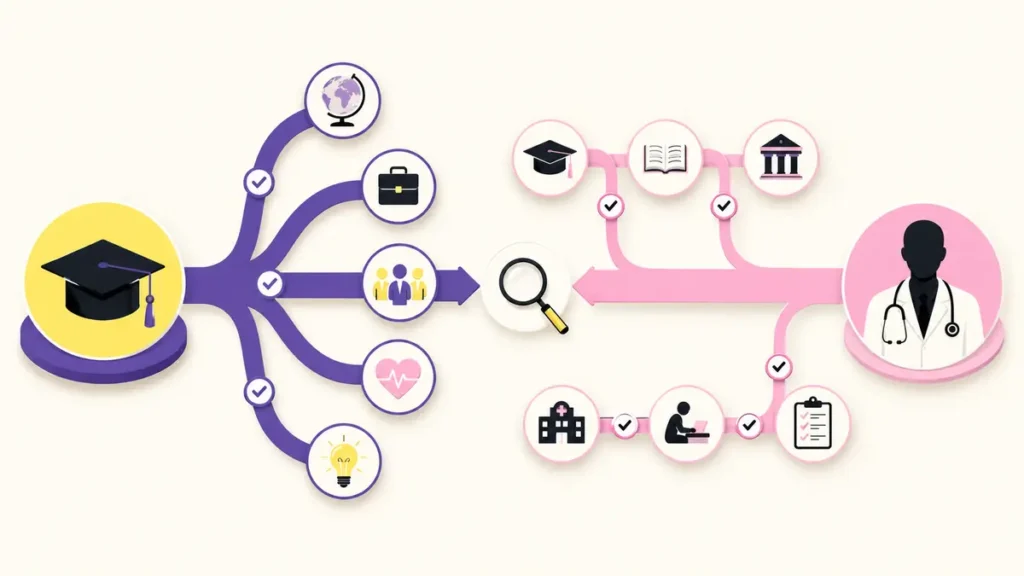
The degree-first versus career-first flowchart
Start: Name your current best career direction—even if it is broad.
Decision 1 → Is a specific qualification or licence normally required?
Yes: research the occupation first, list every formal requirement, and shortlist only qualifying degree routes.
No: continue to Decision 2.
Decision 2 → Do several appealing careers share one broad academic foundation?
Yes: compare flexible degree families, electives, placements and switching options; explore careers in parallel.
No: continue to Decision 3.
Decision 3 → Have you tested either the subject or the work?
No: pause the commitment and run a 30-day evidence test.
Yes: compare your evidence, choose the most reversible next step and set a review date.
Finish: Record what would make you change your mind. A decision is more useful when it includes a review trigger, not just a choice.
Build a one-page decision worksheet
| Question | Your evidence | What it changes |
|---|---|---|
| What tasks does the career involve each week? | Two official profiles plus one conversation with a student or worker. | Confirms whether the direction is based on real work rather than a job title. |
| What qualification is required? | Regulator, professional body or official occupation source. | Shows whether career-first planning is essential. |
| What will I study and how will I be assessed? | Module list, compulsory courses, labs, essays, exams, placements. | Tests whether the degree experience fits your learning strengths. |
| Which options remain open? | Three related roles, transferable skills and switching rules. | Reveals flexibility and the cost of changing direction. |
| What can I test now? | One class, project, interview, visit, shadowing or volunteer task. | Creates lived evidence before a high-cost commitment. |
Add a confidence label beside every claim: verified, partly verified or assumed. This keeps a polished university page, a family opinion or a memorable quiz result from being treated as equal to direct evidence.

A realistic example: Maya chooses the order, not her whole future
Maya is interested in psychology, design and technology. She initially asks, “Should I choose a degree or career first?” Her first imagined career is clinical psychology. Research shows that this is a regulated professional path with specific postgraduate training and local requirements. For that destination, she should work backward from the career. She needs to confirm which undergraduate routes preserve eligibility before comparing universities.
But Maya is also curious about user research, where employers may value research methods, communication, portfolios and relevant experience across more than one degree background. For that broader direction, she can compare flexible degree families—such as psychology, human-computer interaction or social science—then add practical research projects and internships.
Maya does not pick between two identities immediately. She takes an introductory psychology course, completes a small usability-research project and speaks with one trainee psychologist and one product researcher. After 30 days, she reviews which tasks held her attention, which requirements surprised her and which route keeps acceptable alternatives open. Her next decision is informed, but still reversible.
Common mistakes to avoid
Choosing from the title alone. Degree names hide major differences in compulsory modules, assessment styles and placement access. Read the curriculum.
Treating one result as a verdict. Interest, personality or strengths assessments can generate hypotheses. Compare them with repeated behavior, course performance and real tasks.
Optimizing only for the first job. Entry requirements matter, but so do debt, time, location, wellbeing, skill transfer and the ability to adapt.
Waiting for perfect certainty. You are choosing a next step with current evidence, not signing a lifetime contract.
Your 30-day next step
In week one, shortlist two career directions and verify their entry requirements. In week two, compare three degree curricula and mark compulsory modules. In week three, complete one realistic task or speak with someone close to the work. In week four, update your worksheet and choose the smallest sensible commitment.
Set a review date now—after your next course, open day, project or application milestone. At that review, ask: What did I learn? Which assumptions changed? Which option still meets my non-negotiables? What evidence is still missing?
If you remain broadly undecided, start with our guide to choosing a college major when you are undecided. You can also compare your learning evidence with how to choose a major based on your strengths and prepare for family conversations with what to do when parents want a different major.
Frequently asked questions
Is it better to choose a career before a college major?
It is better when the occupation has specific education, accreditation or licensing requirements. For broad or less regulated directions, selecting a flexible degree family and exploring careers alongside it can be equally sensible.
What if I choose a degree but do not know the exact career?
That can work if you understand the curriculum, can name several acceptable directions and deliberately build transferable experience. Revisit the decision each term rather than waiting until graduation to explore work.
Can I change careers after choosing a degree?
Often yes. Many degrees build research, communication, quantitative or problem-solving skills that travel across roles. However, moving into a regulated profession may require additional accredited education or supervised training, so check local requirements early.
Ready to turn your interests into a study-path shortlist? Join RoleQuiz early access for practical study-path recommendations. Use the result as a starting hypothesis, then verify it with curricula, occupation requirements and real-world tests.
Leave a Reply